Showing posts with label Amphibian. Show all posts

Friday, March 22, 2013

Malabar Tree Toad

Pedostibes tuberculosus
The Malabar Tree Toad is a very small, slender species that is found only in the forests around the Western Ghats in India. They are also referred to as the Warty Asian Tree Toad.

If you couldn't guess from the name, these Toads live in the trees that are usually close to a body of water. They are found on the ground as well, as that is where they breed and lay their eggs, but they ascend into the trees during the night time.

Malabar Tree Toads are small little guys, and measure only around 1in in length! (Yes, that is a human fingernail in the picture.. for a size reference.) Females are slightly larger than the males. They can be identified by their warty brown bodies and the black and white bands that run down their sides.

The Malabar Tree Toad is currently listed as Endangered, and its population is on the decline. Its main threat is habitat loss due to the logging and farming industries. They are found within several protected refuges, and are the topic of ongoing study.

IUCN Status : Least Concern
Location : Europe and Asia
Size : Length up to 12in (31cm), Wingspan up to 26in (67cm)
Classification : Phylum : Chordata -- Class : Amphibia -- Order : Anura
Family : Bufonidae -- Genus : Pedostibes -- Species : P. tuberculosus

Tuesday, March 19, 2013

Eastern Newt

Notophthalmus viridescens
Eastern Newts can be found in the Eastern United States, where they have a range that spans all the way from southern Canada down to Texas. They live in fresh bodies of water, typically near forest areas.

Eastern Newts go through some pretty interesting life phases. Adults will mate on land during the early spring, and the female will lay up to 400 eggs a season, one at a time,  in the water. The eggs are attached to aquatic plants, and will hatch in anywhere from 3 to 8 weeks, depending on the temperature.

Larval Newts look just like their adult selves, only much much smaller. They measure only about 7mm long! The larvae spend their summer eating as many little invertebrates as they can. When late summer comes around they metamorphose into their Juvenile or "Eft" form.

Eft Phase
Efts look different from the adults and larvae. For one, they completely lose their gills in favor of a set of lungs. They also have thinner, less powerful tails. Efts live on land for two to four years and feed on terrestrial invertebrates like snails and springtails. They hibernate under logs and rocks during the winter. Eventually they will grow large, flattened tails and return to the water as adults.

Thanks to those tails, adult Eastern Newts are very powerful swimmers. They remain in water for the rest of their lifetimes, and will feed on just about any invertebrate that they can catch. If they make it past the high mortality larval and eft phases, Eastern Newts can live up to 15 years!

IUCN Status : Least Concern
Location : Eastern North America
Size : Length 5in (12.5cm)
Classification : Phylum : Chordata -- Class : Amphibia -- Order : Caudata
Family : Salamandridae -- Genus : Notophthalmus -- Species : N. viridescens

Thursday, March 14, 2013

Mount Nimba Reed Frog

In 2010 this little frog was rediscovered. It had been thought extinct since 1967, which was the last time anyone had seen one.
Hyperolius nimbae

Mount Nimba Reed Frogs are named for the fact that they have only been found at the foot of Mount Nimba in Cote d'Ivoire, West Africa. It is speculated that they may also live in Guinea and Liberia, but no one has yet confirmed this.

Mount Nimba Reed Frogs live in lowland forests near swamps and bodies of water. They have red limbs that make them rather visible.

The species is listed as Endangered, and though parts of Mount Nimba are protected as a nature reserve, the site could use better protection and regulation. The Reed Frog is not the only threatened species in the area. Other residents include Chimpanzees and toads that give live birth!

IUCN Status : Endangered
Location : West Africa
Size : Length 1.3in (3.3cm)
Classification : Phylum : Chordata -- Class : Amphibia -- Order : Anura
Family : Hyperoliidae -- Genus : Hyperolius -- Species : H. nimbae

Wednesday, March 13, 2013

Eastern Tiger Salamander

Ambystoma tigrinum
The Eastern Tiger Salamandar is the largest land-dwelling Salamander is all of North America, and it also has the distinction of being the most widespread. You'll find these guys just about everywhere on the continent except in the coldest northern reaches-- they live throughout the United States, Mexico, and in most of Canada.

You can identify Eastern Tiger Salamanders by their large size and their blotchy green and black markings. As adults they are almost completely terrestrial, and live in burrows that can be as far as two feet underground. They live in a huge range of habitats, including forests, grasslands, and developed areas.

Adults are very loyal to their birthplace, and will return to that spot to breed int eh Spring. Larges numbers will congregate on a single spots, and males will have to isolate the females from the group in order to breed. Males will deposit spermatophores that are picked up by the females to fertilize the eggs. Sometimes other males will actually interrupt this process, deposing the first male on the scene and then placing his own spermatophores. Once the eggs are fertilized, they are laid in masses that number up to 100. The young Salamanders are completely aquatic, but grow very fast-- by the end of summer they have already become adults.

IUCN Status : Least Concern
Location : North America
Size : Length up to 14in (36cm)
Classification : Phylum : Chordata --Class : Amphibia -- Order : Caudata
Family : Ambystomatidae -- Genus : Ambystoma -- Species : A. tigrinum

Saturday, March 9, 2013

African Bullfrog

Pyxicephalus adspersus
Happy Leap Day! To celebrate, let's learn about one of my favorite "leapers," the monstrous and voracious African Bullfrog!

These frogs are some of the largest in the world, with some males weighing up to 4.5lbs! Males are larger than females, a trait that is not especially common among frogs (females are often larger). Regardless of sex, African Bullfrogs have broad bodies, short snouts, and a dull green coloration. They also have teeth in their lower jaw!

African Bullfrogs are very, very aggressive, especially when it comes time to mate. Males can get incredibly territorial, both before and after mating. Once the females lay their eggs (up to 4,000 of them!) the males stick around to guard them, fighting off any attackers. Unfortunately, the mortality rate for the young frogs is very high. Only 20% of all females will reach adulthood.

I mentioned earlier that African Bullfrogs are voracious. They will eat just about anything that they can fit in their mouth, from small insects, to mice, to birds, and even other frogs! They use those lower jaw teeth to grab on to struggling prey.

One final fact that I found really interesting is that African Bullfrogs hibernate.... but not in the way one normally thinks of. Instead of hibernating during the cold winters, they hibernate during the hot, dry summers. They burrow deep down into the soil and then develop a watertight cocoon made from dead skin. This enables them to retain fluids and not dry out during this troublesome season.


IUCN Status : Least Concern
Location : Africa
Size : Length up to 9.5in (24cm), Weight up to 4.5lbs (2kg)
Classification : Phylum : Chordata -- Class : Amphibia -- Order : Anura
Family : Ranidae -- Genus : Pyxicephalus -- Species : P. adspersus

Thursday, February 28, 2013

Hong Kong Newt

Paramesotriton hongkongensis
Hong Kong Newts are the only Salamanders found within the territory Hong Kong, though they can also be found in a few other parts of the surrounding area. They can be found in and around slow flowing streams and pools that have sufficient pebble coverage for hiding. Hong Kong Newts do not hibernate  and can be spotted year round.

You can identify these smallish Amphibains by their brown, warty bodies and vibrant orange-spotted undersides. Those bellies are used as a warning to drive predators away. They themselves feed on worms, crustaceans, tadpoles, insects, and small fish.

As with most Amphibians, Hong Kong Newts go through a metamorphosis as they grow. Their tadpole stage has black skin and pink gills, and they have spotted stomachs, but those are yellow instead of orange. The Larvae hatch at around 14mm, and reach their final transitional stage at around 40-44mm. It can take as long as 3 years to reach full sexual maturity.

The major threat facing the Hong Kong Newt is collection for the pet trade. The population is protected in Hong Kong, but is on the decline. Luckily they are able to be bred in captivity, so they aren't in major danger of going extinct just just. They do very well in captive environments, and are said to be quite hardy as adults.

IUCN Status : Near Threatened
Location : Hong Kong
Size : Body Length up to 15cm
Classification : Phylum : Chordata -- Class : Lissamphibia -- Order : Caudata
Family : Salamandridae -- Genus : Paramesotriton -- Species : P. hongkongensis

Friday, February 22, 2013

Sulawesi Fanged Frogs

Fanged Frog
A few weeks back stories began popping up about new species of Fanged Frogs found on the Indonesian island of Sulawesi. Nine of the thirteen species located there had not been previously known to science. These thirteen species, found within the genus Limnonectes, were able to evolve in amazing ways in order to fill specific niches on the island. This is due to the fact that they face no competition from frog species found in other areas.

But before we get into some of those adaptations, what is the deal with those fangs? Well you see, they aren’t actually teeth at all, but bony protrusions that extend up from the jaw. Because these species have only just been discovered, scientists aren’t completely sure about their purpose. One theory is that they help the frogs to catch fast moving aquatic prey. The rationale for this is that the frogs that have the largest fangs are the ones that feed on fish and tadpoles.
Fanged Frog guarding Jelly-Like Eggs

Interestingly, the some of the fish eating frogs are also incredibly large. Almost double the size of some other species. This may be because they need to swim against strong moving currents.
Large size is only one of the adaptations found in the Sulawesi Fanged Frogs. A different species, which dwells on land, lays thick jelly-like eggs so that their offspring can go through their early life phases without being near water. Foot webbing also varies across the frog species, with those living in watery habitats have larger webs than those who live more on dry land.

It’s pretty awesome when you realize that these thirteen related species all specifically evolved differently to satisfy niches on their little island. And they did it in only 15 million years!

Location : Sulawesi, Indonesia
Size : Varies
Classification : Phylum : Chordata -- Class : Amphibia -- Order : Anura
Family : Dicroglossidae -- Genus : Limnonectes

Friday, February 8, 2013

Archey’s Frog

Leiopelma archeyi
The Archey's Frog is a very primitive looking species, in that it looks very much like 150 million year old fossils. It also has some anatomical features that are rather uncommon, including tail wagging muscles (but no tail), no external eardrums, an extra back vertebrae, and no true vocal chords. Some females also have a special extra W-Chromosome, which determines sex.

There are four species within the Leiopelmatidae family, a group that diverged from all other frogs around 200 million years ago. This fact isn't surprising when you learn that they hail from New Zealand, a location whose eventual split off and isolation led it to evolve all sorts of creatures found no where else in the world (Tuatara and Kakapo anyone?)

The Archey's Frog (named for former Director of the Auckland Institute and Museum, Sir Gilbert Archey) is the smallest member of its family. The females can reach sizes of about 37mm, while males are a bit smaller at 31mm. They are terrestrial and nocturnal, and they even lay their eggs on land (in damp soil and leaf litter).

Because of their terrestrial lifestyle, the Archey's Frogs do not metamorphose from tadpole to adult. They actually hatch as tiny little froglets. The males will guard over their eggs, and then the froglets, even letting their offspring ride around on their backs.

Archey's Frogs are listed as Critically Endangered, and the population has been on the decline since at least 1996 (when a study specifically targeting decline was done). Climate change, habitat loss, and the introduction of predators and competing animals are all factors that have affected the species. Archey's Frogs are protected by the New Zealand Department of Conservation, and their population continues to be monitored.

IUCN Status : Critically Endangered
Location : New Zealand
Size : Length up to 35mm
Classification : Phylum : Chordata -- Class : Amphibia -- Order : Anura
Family : Leiopelmatidae -- Genus : Leiopelma -- Species : L. archeyi

Thursday, January 31, 2013

Two-toed Amphiuma

Amphiuma means
The Two-toed Amphiuma is actually one of the longest Salamanders in the world, and the longest in the United States, capable of reaching lengths of 3-4ft! You can find these long, eel-like Amphibians in the slow moving, often stagnant waters of the southeastern parts of the country. Though they are sometimes referred to as "Conger Eels" or "Congo Snakes," they are still Amphibians.

The species gets its common name from their odd little feet. They have four tiny little vestigial legs, each one ending in two toes. These legs are pretty much useless, which is good, cause they don't particularly need them for anything. Two-toed Amphiumas are almost exclusively aquatic.

Their underwater lifestyle explains their tiny legs, their long bodies, lidded eyes (as juveniles), and their incredibly slippy skin. Curiously though, they have no external gills as adults, and they posses fully formed lungs!

If you see one of these interesting Amphibians, leave it alone! Though not venomous, they have really nasty bites if handled incorrectly.

IUCN Status : Least Concern
Location : Southeast United States
Size :  Length up to 4ft (1.2m)
Classification : Phylum : Chordata -- Class : Amphibia -- Order : Caudata
Family : Amphiumidae -- Genus : Amphiuma -- Species : A. means

Tuesday, January 29, 2013

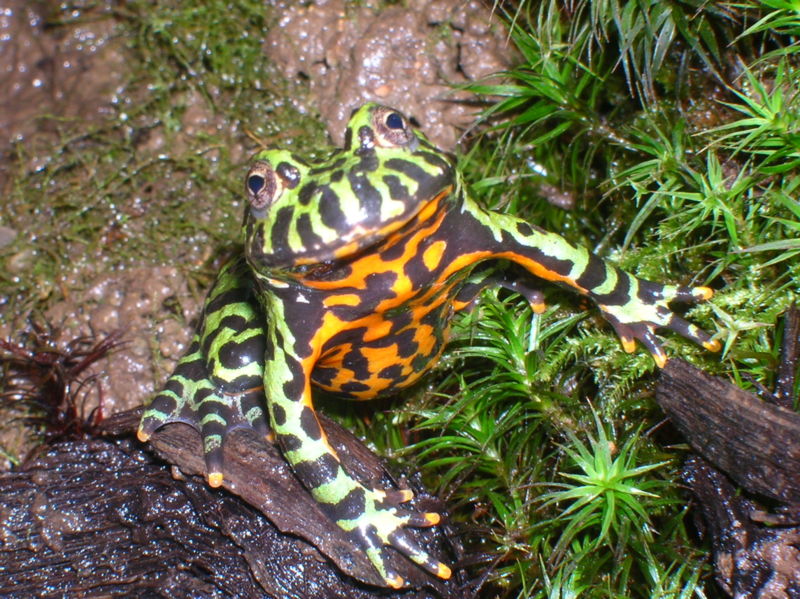
Oriental Fire-bellied Toad

Bombina orientalis
Oriental Fire-bellied Toads are aquatic amphibians that cane be found in China, Korea, Japan, and parts of southern Russia. They are referred to as Toads not because they belong to the Toad family, but because they have warty, toad-like skin. Isn't animal naming confusing sometimes?

On any normal viewing, the Fire-bellied Toad will appear green with a black mottle pattern. However, once they are threatened they will rise on their hind legs and present their smooth, bright red and black underside to the predator, sometimes doing a near back-flip in the process! The red color warns against the dangerous toxin that the Toad secretes from its skin.

Oriental Fire-bellied Toads are very common throughout most of their range, and they are also kept as pets in captivity. They are very hardy, require only a 10 gallon aquarium, are considered to be suitable for beginning Frog keepers, and can live ten years or more!

IUCN Status : Least Concern
Location : East Asia
Size : Length 2in (5.5cm)
Classification : Phylum : Chordata -- Class : Amphibia -- Order : Anura
Family : Bombinatoridae -- Genus : Bombina -- Species : B. orientalis

Monday, January 28, 2013

Metoposaurus

Metoposaurus
Though amphibians today are small and tend to take a backseat to larger vertebrates in terms of dominance, they were once some of the top land animals on the planet! During the Carboniferous and Permian periods, before the dawn of the Dinosaurs, Amphibians were some of the largest land animals around, and the size even carried over for millions of years after the Permian ended.

Meet Metoposaurus, an amphibian that measured up to 10ft long and lived during the Triassic over 220 million years ago. Though unrelated, it did share some physical similarities to modern alligators and crocodiles- a long, broad snout, sharp teeth, and a long tail that helped to propel them through water.

Metoposaurus was an aquatic hunter, as evidence by the tail and by the fact that their limbs were relatively weak. Scientists think they may have even used their arms like flippers! Even so, I wouldn't want to mess with a 1,000lb tetrapod!

Status : Extinct for 220 million years
Location : Europe and North America
Size : Length up to 10ft (3m)
Classification : Phylum : Chordata -- Class : Amphibia -- Order : Temnospondyli
Family : Metoposauridae -- Genus : Metoposaurus

Thursday, January 24, 2013

Mexican Burrowing Toad

Rhinophrynus dorsalis
Mexican Burrowing Toads are the most evolutionarily distinct amphibians in the entire world. They are the only members of their genus, and of their entire family, and are separated from their nearest relatives by 190 million years of independent evolution!  That means that the last time they diverged from another modern family was at the beginning of the Jurassic Period!

Though many evolutionarily distinct animals are rare and endangered, the Mexican Burrowing Toad is actually pretty common in its current range in Mexico and Central America. And before they died out millions of years ago, other members of this distinct family spanned across North America!
Mexican Burrowing Toads are named for the burrows that they spend a great deal of time in. They remain in them during winter and times of drought. And they aren't often seen outside during the other times of year unless heavy rains force them above ground or they wish to mate.
They can mate during all months of the year, and lay their eggs in water above ground. Mexican Burrowing Toads make very loud, low-pitched calls, both to attract mates and to cry out in alarm. When alarmed, these Toads also puff up and resemble flattened balloons!

The Mexican Burrowing Toad population is now stable, and they really don't face any major threats as far as the IUCN is concerned. They are protected under Mexican law, and live in protected zones of other countries as well.

IUCN Status : Least Concern
Location : Mexico, Central America
Size : Length up to 3in (7.5cm)
Classification : Phylum : Chordata -- Class : Amphibia -- Order : Anura
Family : Rhinophrynidae -- Genus : Rhinophrynus -- Species : R. dorsalis

Tuesday, January 15, 2013

Gray Tree Frog

Hyla versicolor
Though the common name identifies this species as the Gray Tree Frog, the scientific name is a bit more accurate. Hyla versicolor alludes to the fact that these frogs can actually change color- their skin can slowly change to match their surroundings, moving from gray to green to white to brown to black! They also sport some vibrant yellow patches under their hind legs, though they are difficult to see unless the frogs are in mid-leap.

Gray Tree Frogs can be found in the eastern United States and in southern Canada. They are relatively small compared to other species in that range. As their name suggests, they live up in the trees. Breeding is pretty much the only activity that motivates them to leave their tree.

If you live in their range, you may have heard their calls! On warm nights during the breeding season the males produce very loud buzzing trills. These calls are made while the males are hiding in vegetation near bodies of water. Females are attracted to these sounds, will enter a male's territory, mate, and then lay her eggs in the nearby water. Calling rarely occurs outside of the breeding season.

IUCN Status : Least Concern
Location : North America
Size : Body length up to 2in (5cm)
Classification : Phylum : Chordata -- Class : Amphibia -- Order : Anura
Family : Hylidae -- Genus : HylaSpecies : H. versicolor

Pyrenean Brook Salamander

Calotriton asper
As the name suggests, the Pyrenean Brook Salamander (sometimes called the Pyrenean Newt) is endemic to Europe's Pyrenean Mountains. They live in clear, oxygen-rich mountain streams and lakes, and live at a variety of altitudes ranging from around 175m to 2900m. The species can be identified by its squarish head and warty skin.

Pyrenean Brook Salamanders live most of their lives in the water, though they do have very flattened bodies and heads that allow them to hide under rocks at the waters' edge. Mating takes place after waking up from hibernation, and the eggs are laid underwater.

The length of the larval stage depends a lot on the altitude in which the Salamanders are living. The stage last around 14 months for those at lower altitudes, but can take as long as two years for those higher up on the mountain. Pyrenean Brook Salamanders can live as long as 20 years.

The species is still relatively safe overall, due to their large range. However, some local populations are becoming scarce and even extinct, due to habitat loss from damming, development, and pollution.

IUCN Status : Near Threatened
Location : France and Spain
Size : Length up to 5.5in (14cm)
Classification : Phylum : Chordata -- Class : Amphibia -- Order : Caudata
Family : Salamandridae -- Genus : Calotriton -- Species : C. asper

Thursday, January 10, 2013

Confusing Toad

Incilius perplexus
Meet the Confusing Toad, which has certainly confused scientists when it comes to their classification! I've found three different possible genus names for this little guy, dating back to 1943, though it looks like the most recent classification (in 2008) has stuck. Incilius perplexus it is!

The Confusing Toad also happens to be a very Endangered Toad. They are endemic to one small area of Mexico-- the Tepalcatepec Basin to be exact. They may live in other areas as well, but so far only that location has yielded any sightings.

Confusing Toads live near streams and ponds around tropical rain forests. Unfortunately, these same areas are under constant threat from agricultural and commercial development. The Toad population is on the decline, and they unfortunately do not live in any protected areas. If they go extinct, the Confusing Toad may remain a rare and confusing species forever.

IUCN Status : Endangered
Location : Mexico
Classification : Phylum : Chordata -- Class : Amphibia -- Order : Anura
Family : Bufonidae -- Genus : Incilius -- Species : I. perplexus

Wednesday, January 9, 2013

Paedophryne amauensis

Have you ever wondered what the smallest vertebrate in the world is? Well today is your lucky day to find out! The honor goes to a tiny, itty bitty little frog found in Papua New Guinea, Paedophryne amauensis!

Paedophryne amauensis
So how small is this wee Amphibian? Well... that picture there should tip you off- it's sitting on a US dime! You're seeing it right; P. amauensis measures only around 8mm, which is less than half the diameter of the ten cent coin.

The species is a very newly discovered one; it was first spotted in 2009 and published about just this month. It's no wonder that the species was hard to spot, as they live on the rainforest floor and blend in with all of the substrate and foliage. They also make calls that sound more like those of an insect than a frog!

P. amauensis is helping scientists to understand the limits of vertebrate size. Because there are so many anatomical features involved in being a member of the Chordata phylum, there is a lot that needs to be stuffed into an extra-tiny package. The frog has adapted for its smallness by having shorter fingers and toes and a simplified skull. Their small amount of surface area also means that they need to live in very wet areas so that they don't dry out. But, just like bigger frogs, they slurp up insects... albeit very tiny ones.

There has already been some controversy about the "smallest vertebrate title," as Ichthyologists are claiming that the crown should really go to the males of a species of Anglerfish. They are only 5mm long, but are lacking some vital organs and essentially live as parasites off of the much larger females. Herpetologists are countering that they are looking at a species average size, which would place the Anglerfish out of the running.

IUCN Status : Not Evaluated
Location : Papua New Guinea
Size : Length .27in (7.7m)
Classification : Phylum : Chordata -- Class : Amphibia -- Order : Anura
Family : Microhylidae -- Genus : Paedophryne -- Species : P. amauensis