Showing posts with label Feline. Show all posts

Thursday, March 28, 2013

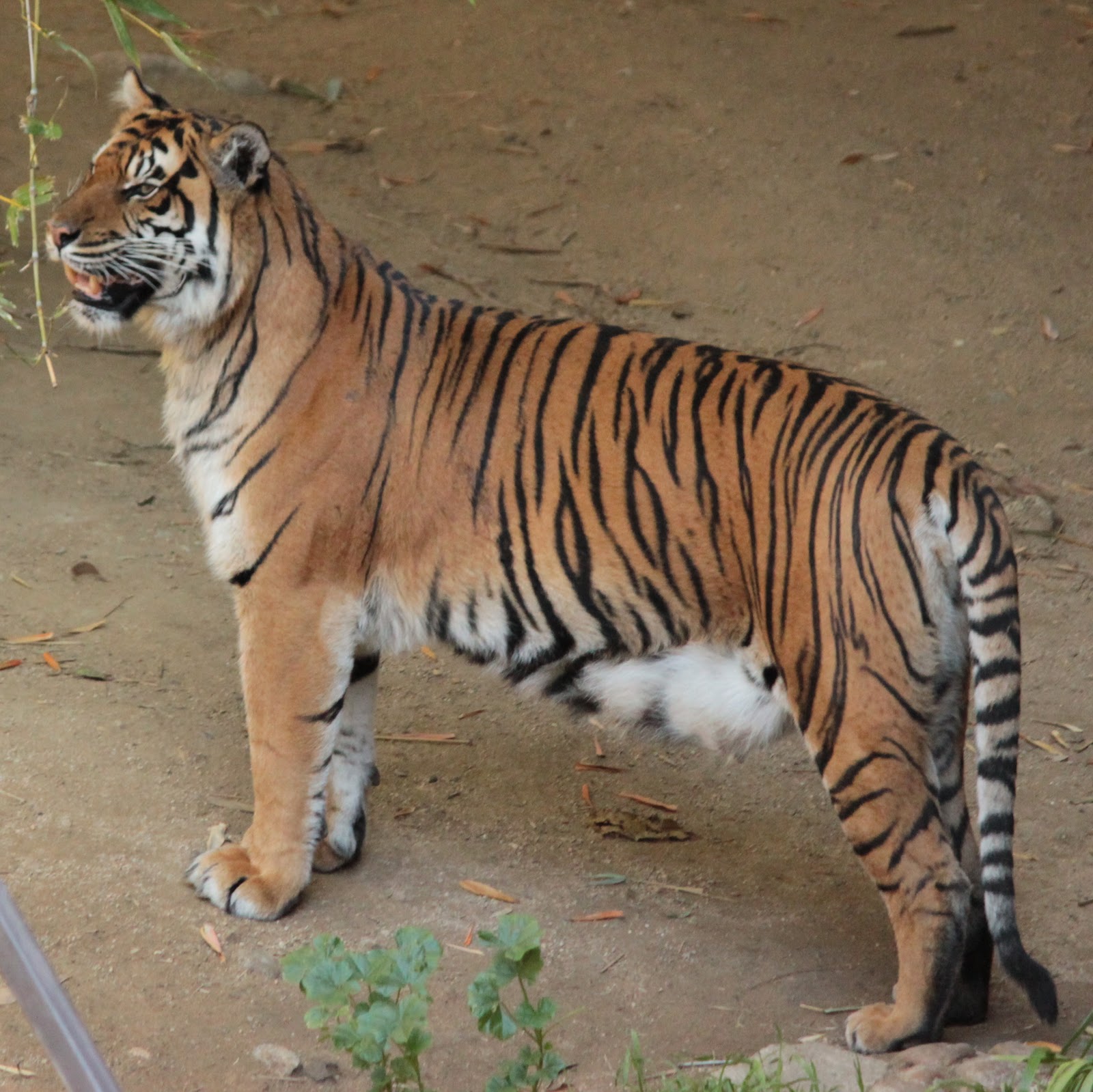
Sumatran Tiger

So to carry on with my unofficial theme of "cool animals I saw in California Zoos" we come to the Sumatran Tiger. This subspecies is found only on the Indonesian island of Sumatra, and is the smallest of all the extant tigers. For a quick size comparison- the Siberian, or Amur Tiger, the largest of the subspecies, can weigh as much as 475lbs. The Sumatran only reaches around 260lbs.

Once upon a time there were two other subspecies that were closely related to the Sumatran Tiger- the Bali and Javan Tigers. Both went extinct during the 20th century, and the Sumatran Tiger could very well meet that same fate. They are listed as critically endangered, and there could be as few as 400 left in the wild.

It is now illegal to hunt the tigers, but poaching continues to be a major problem (hunting was the major contributor to the extinction of the other Indonesian subspecies). Tiger bones and other body parts are frequently found in countries that no longer have Tiger populations, as their is a high demand for those parts within traditional medicine. Unfortunately as the Tiger population drops, the supply cannot meet the demand and the black market prices grow higher and higher. This only continues to motivate poaching.

Thankfully there are a number of Sumatran Tigers in zoos worldwide, and captive breeding has proven sucessful in a number of locations. The Los Angeles Zoo, for example, had three cubs born this past fall (one has sadly passed away). Those cubs marked the third litter born at the zoo to mother "Lulu."

IUCN Status : Critically Endangered
Location : Sumatra, Indonesia
Size : Length up to 8ft (2.5m), Weight up to 260lbs (118kg)
Classification : Phylum : Chordata -- Class : Mammalia -- Order : Carnivora
Family : Felidae -- Genus : Panthera -- Species : P. tigris -- Subspecies : P. t. sumatrae

Tuesday, March 26, 2013

Proailurus

Proailurus lemanensis
Meet Proailurus, a cat-like creature from the early Miocene that is shrouded in taxonomic mystery. Its fossils have been found in Europe and Asia, dating back 25-20million years.

Proailurus looked quite a bit like modern Fossas-- they had long bodies and short arms. They also possessed the same binocular vision as modern cats, and a similar dental structure. These prehistoric cats most likely climbed trees and stalked their from their as present-day leopards do.

But is Proailurus a true feline? Or is it even more than that? Many believe that Proailurus is the common ancestor for all cats, but it may also be a common ancestor for other creatures as well. A recent genetic study has placed Proailurus into the Feloidea superfamily, which also encompasses the Hyenas and Viverrids (like the aforementioned Fossa). Additional fossils and genetic studies may shed more light on this in the future.

Status : Extinct for 20 million years
Location : Fossils founds in Europe and Asia
Size : Length around 2ft (60cm),Weight around 20lbs (9kg)
Classification : Phylum : Chordata -- Class : Mammalia -- Order : Carnivora
Family : Felidae S -- Genus : †Proailurus -- Species : †P. lemanensis

Sunday, March 24, 2013

African Wildcat

Felis silvestris lybica
Most people understand that dogs were domesticated from Grey Wolves, but the ancestry of the domestic cat isn't as widely known. Enter the African Wildcat, a Wildcat subspecies that is responsible for all of the housecats we have today!

There are several different Wildcats around the world, spanning across Europe, Asia, and Africa. Though they are all genetically similar, and they all look a heck of a lot like domesticated cats, it is one particular African subspecies (F. s. lybica) that ended up being domesticated by Middle Eastern civilizations around 10,000 years ago.

African Wildcats live throughout the African continent, as well as on the Arabian Peninsula and near the Caspian Sea. There are actually over a dozen subspecies on the continent aside from the domestic ancestor. They live in most habitats, including deserts, forests, and savannas.

The African Wildcat is, unsurprisingly, a carnivore. They hunt by pouncing, and go after small mammals, reptiles, birds, and amphibians. Hunting is done primarily at dawn and dusk. The are solitary animals for the most part, except when a  female is raising a litter of kittens.

The entire Wildcat species is listed as being of Least Concern, but they do face some conservation challenges. The most prominent of these is hybridization; many of the African Wildcats interbreed with domestic cats, resulting in very few genetically pure populations.

IUCN Status : Least Concern
Location : Africa
Size : Body Length around 30in (76cm), Weight up to 14lbs (6.5kg)
Classification : Phylum : Chordata -- Class : Mammalia -- Order : Carnivora
Family : Felidae -- Genus : Felis -- Species : F. silvestris -- Subspecies : F. s. lybica, others

Saturday, March 23, 2013

Barbary Lion

Wild Barbary Lion, photographed in 1893
Barbary Lions are members of a Lion subspecies that once lived throughout northern Africa. They are now considered to be extinct in the wild. There may be some captive specimens left, but there is some controversy as to whether many are true members of the subspecies.

The history of the Barbary Lion is a storied one. They were once fought off by the ancient Egyptians, and they were captured by the Romans for use in gladiatorial events. They also lived in the English Royal Menagerie (and later in the Tower of London) as far back as the 12th and 13th centuries. Morroccan Kings and Sultans  kept Barbary Lions, and there are some captive individuals today who are said to be descendants of the "Royal Lions."

Barbary Lions were huge. Adult males could weigh as much as 600lbs, making them the largest of the subspecies. They also had shaggy manes that extended well beyond their necks, reaching to their backs and even covering their undersides. They also had a grayer coloration to their manes than other Lions.

Possible Captive Barbary Lion
Interestingly, Barbary Lions have more in common genetically with Asiatic Lions than with other African Lions. This may be because of the large Saharan divide between the Barbary Lions and their southern relatives. Another theory is that the now completely extinct European Lion helped to bridge the gap between the cats living in North Africa and Asia.

Once upon a time it was believed that any long maned lion could be a descendant of the wild Barbary Lions. This has been proven untrue. Lion mane size is actually dependent on outsides factors, including temperature. After the last Barbary Lions were killed, various zoos and organizations claimed to have these lions in captivity, including Lions related to the Royal Lions in Morocco. Genetic testing on museum specimens (and on skulls from the Tower of London!) has helped to identify markers of the subspecies, but there is still a great deal to be known about their genetic distinctness. Until everything gets sorted out, efforts are being made to keep the remaining lions in their own selective breeding group.

IUCN Status : Extinct in the Wild since the 1920s
Location : North Africa
Size : Weight up to 600lbs (272 kg) in males, 400lbs (180kg) in females
Classification : Phylum : Chordata -- Class : Mammalia -- Order : Carnivora
Family : Felidae -- Genus : Panthera -- Species : P. leo -- Subspecies : P. l. leo

Wednesday, March 6, 2013

Munchkin

Munchkin Cat
The Munchkin is a very new breed of cat that has only been around for 30 years or so. Its creation has led to controversy, as there are many who believe that significant health issues will arise, and that the breed itself is based completely on a mutation.

Munchkins have very short legs, similar to the Dachshunds and Corgis in the dog world. This trait is genetic, and cats sporting the short legs were reported back in the 1940s. In 1983 in Louisiana, a woman found a pregnant stray and took her in. Half of the resulting kittens had short legs, and it is from that cat that the Munchkin breed descends from.

There was uproar in the early 90s when the breed was first introduced to the cat show circuit. Many believed that these cats would end up having major hip and spine problems, but so far there has been little conclusive evidence for this-- the problems that have arisen are those that can be found across many species of domestic cat. Though there is the issue of breeding-- two crossed Munchkins are likely to have a very small litter size, as kittens with the trait are often non-viable.

The controversy continues, as several cat organizations do not, and will not officially recognize the breed. They cite that it is a cat based upon an abnormality and a genetic disease, and that they are un-sound. There are a handful of registries that do recognize them, including TICA and the United Feline Organization.

Status : Domesticated
Location : United States
Size : Weight upt o 9lbs (4kg)

Classification : Phylum : Chordata -- Class : Mammalia -- Order : Carnivora
Family : Felidae -- Genus : Felis -- Species : F. catus

Tuesday, February 19, 2013

Rusty-spotted Cat

Prionailurus rubiginosus
The Rusty-spotted Cat is one of the smallest cat species in the world, and as adults they weigh only a tiny 3.5lbs. For a comparison, that makes them less than half the size of a normal domestic cat!

You'll find these mini-felines in India and Sri Lanka, though good luck spotting one in the wild. They are incredibly secretive and difficult to locate due to their camouflaged fur and small size. It also doesn't help that they have a generally small population size-- it is estimated that less than 10,000 adults remain.

Rusty-spotted Cats are nocturnal and partially arboreal. They often sleep in trees, and flee up into them to escape their own predators, but they do most of their hunting on the ground. Rodents, birds, and small reptiles make up their diet.

Deforestation and the spread of agriculture has hurt this population immensely. They are listed as Vulnerable, are protected throughout most of their range, and are listed in CITES I (in India) and CITES II (in Sri Lanka). However, the population is still on the decline. They are kept in a handful of zoos, but are not common in captivity.

IUCN Status : Vulnerable
Location : India, Sri Lanka
Size : Length up to 19in (48cm), Weight up to 3.5lbs (1.6kg)
Classification : Phylum : Chordata -- Class: Mammalia -- Order : Carnivora
Family : Felidae -- Genus : Prionailurus -- Species : P. rubiginosus

Monday, February 18, 2013

Abyssinian Cat

Abyssinian
The Abyssinian Cat is yet another domesticated creature that has a slightly confusing back-story. The breed gets its moniker from Abyssinia, an old place name for what is now Ethiopia. Only... there is no evidence that the cats actually came from Ethiopia.

It is more likely that the breed developed further north in Egypt, and before that came from ancestors in Southeast Asia. The cats strongly resemble the felines painted in Ancient Egyptian wall murals, and recent genetic studies show resemblances to cats around the Indian Ocean.

The ancient origins may never be fully understood, but the modern ones are a little bit more clear (with some exceptions of course). The Abyssinian breed as we know it today was first bred in the United Kingdom at the end of the 19th century. Some claim that the cat who started to whole line was a female named Zula who was imported in the 1860s. However, there is no concrete evidence that this story is true. What is factual is that all current pedigreed Abyssinians come from cats bred in the United Kingdom.

In the past 150 years or so, Abyssinians have become incredibly popular. This is thanks to their unusual coloration and their playful, intelligent nature. They are described as being incredibly curious and active, and many turn out to be excellent climbers around the house!

Abyssinians have what is called a "ticked" coat, which is found in only three breeds (the Somali and a the Singapura being the other two). Each hair actually has three or four distinct bands of color, with a very light band at the root and a darker band at the tip. Abyssinians are typically seen in various shades of brown and cream.

Status : Domesticated
Location : Developed in the Untied Kingdom
Size : Length up to 2ft (60cm)
Classification : Phylum : Chordata -- Class : Mammalia -- Order : Carnivora
Family : Felidae -- Genus : Felis -- Species : F. catus

Saturday, February 2, 2013

Jaguarundi

Puma yagouaroundi
The Jaguarundi is a small, strange looking feline with an elongated body and short legs. One of their alternate common names is "Otter Cat," and it's not much of a stretch to see why. They are also sometimes confused with Tayras!

Jaguarundis have a range that spans from Texas all the way to Argentina, and are most commonly found in open areas. They are solitary cats, and are primarily diurnal, though they sometimes hunt through dawn and dusk as well. Jaguarundis spend most of their time on the ground, though they are able to both climb and swim quite well.

Small mammals, birds, and fish make up the Jaguarundi's diet. They typically hunt by stalking and pouncing, and mothers teach their cubs how to hunt during their first year of life.

Finally, can you guess who the closest relative to the Jaguarundi is? It's not any of the other small cats, nor is it the Jaguar. Despite their massive size difference, Cougars and Jaguarundis are the only two living species in their genus!

IUCN Status : Least Concern
Location : Central and South America
Size : Body Length 30in (77cm), Weight up to 20lbs (9kg)
Classification : Phylum : Chordata -- Class : Mammalia -- Order : Carnivora
Family : Felidae -- Genus : Puma -- Species : P. yagouaroundi

Wednesday, January 23, 2013

American Cheetah

Miracinonyx trumani
The American Cheetah is a cat surrounded in taxonomic controversy. Are they Cheetahs? Are they Pumas? Are they both? Unfortunately, the two species, M. inexpectatus and M. trumani, are known only from fragmentary fossils, so until more turns up it will be difficult to know for sure!

What we do know is that the two species lived in North America during the Pleistocene, from around 3 million to 10,000 years ago. They had characteristics that were very similar to modern Cheetahs (who themselves are taxonomically distinct from all other extant cats). Flat faces, short nasal cavities, flexible backs, and long legs are all similarities between the modern and extinct cats.

However, those similarities might just be due to a case of convergent evolution. There is some evidence to suggest that these Cats are actually relatives of Pumas and Cougers, not Cheetahs. They may have just evolved in the same way as the Cheetah, due to the fact that they lived in the same open plains and hunted the same type of prey. Interestingly, there is a theory that Pronghorn Antelopes, some of the fastest land animals alive, evolved their speed directly as a response to the fast American Cheetahs that hunted them!

There will continue to be questions about the American Cheetahs until we uncover more fossils and information. It may even come to pass that the two species are split up from one another-- M. trumani, for example, is more Cheetah-like than M. inexpectatus.

Status : Extinct for around 10,000 years
Location : North America
Size :  Body length up to 67in (1.7m)
Classification : Phylum : Chordata -- Class : Mammalia -- Order : Carnivora
Family : Felidae -- Genus : Miracinonyx

Sunday, January 13, 2013

Cornish Rex


Cornish Rex
Though they look a bit like the cats depicted in Ancient Egyptian art, Cornish Rexes actually originated in England, and were only developed about 60 years ago!

The story begins around 1950, when a natural mutation occurred in a litter born in Cornwall. This first Cornish Rex, Kallibunker, had a curly coat unlike his siblings. The owners of the cat struggled to create a new breed, but so much inbreeding was involved (inbreeding may have been the reason for the recessive gene mutation in the first place) that they gave up on the project. The breed development was then in the hands of others who had received offspring of Kallibunker.

Because Cornish Rex cats were so inbred at first, it is necessary to create crosses with other breeds in order to maintain genetic diversity.

Cornish Rexes come in more color varieties than I can count, but all possess the short, curly coat, high cheekbones, and large ears. They are not hypoallergenic. Personality-wise, Cornish Rexes are active, intelligent  affectionate cats.

Status : Domesticated
Location : Cornwall, England
Classification : Phylum : Chordata -- Class : Mammalia -- Order : Carnivora
Family : Felidae -- Genus : Felis -- Species : F. catus

Sunday, January 6, 2013

Fishing Cat

Prionailurus viverrinus
On the outside the Fishing Cat may just look like a gigantic (up to 35lbs!) House Cat, but they are in fact very, very wild. These nocturnal felines are native to South and Southeast Asia and live in habitats that are close to water, blowing away the stereotype that all cats dread being wet.

Fishing Cats didn't get their name for nothing. They are excellent swimmers and primarily eat aquatic creatures, like amphibians, fish, and ducks. In order to snatch their water-dwelling meals, they stand in the shallows and scoop passing critters with their paws. They are also able to dive after prey as well!

In the wild, young Fishing Cats learn to hunt from their mothers, who they remain with until about 10 months of age. Interestingly, male Fishing Cats have helped to raise young in captivity.

Unfortunately, loss of habitat due to pollution and clearing has led Fishing Cat populations to decline, and they are now considered Endangered by the IUCN. They are also hunted in many places for their fur, and for ingredients in traditional medicines.

IUCN Status : Endangered
Location : South Asia
Size : Body length up to 31in (80cm), Weight up to 35lbs (16kg)
Classification : Phylum : Chordata -- Class : Mammalia -- Order : Carnivora
Family : Felidae -- Genus : Prionailurus -- Species : P. viverrinus

Monday, December 31, 2012

European Jaguar

Panthera gombaszoegensis
The modern big cats are spread all over the world, but then to have very distinct ranges. Tigers in Asia. Cheetahs in Africa. Jaguars in South America. But in the past this was not the case. Lions lived in Europe and Asia. There was a strange Cheetah-like cat in North America, and today we'll learn that there were Jaguars in Europe.

The European Jaguar lived about 1.5 million years ago, and its fossils have been found throughout central and western Europe. These cats were larger than their cousins who now live halfway around the world, reaching nearly 450lbs in size. They were probably solitary creatures, and their size allowed them to take down large prey.

European Jaguars were so similar to the big cats of today that they belong to the very same genus (Panthera). There are even some who think they might be a subspecies of modern Jaguars!

So if there were Jaguars in Italy, how the heck did they all end up in South America 1.5 million years later? Well, there were also Jaguars in Asia. And those Asian Jaguars spread about a few million years ago. Some eventually made their way into the America, while others moved west to Europe. Eventually the European and Asian lines died out (possibly due to competition with other large cat species), but the South American Jaguar, the only large Cat in its range, flourished.

Status : Extinct 1.5 million years
Location : Europe
Size : Length up to 20ft (6m), Weight up to 460lbs (210kg)
Classification : Phylum : Chordata -- Class : Mammalia -- Order : Carnivora
Family : Felidae -- Genus : Panthera -- Species : P. gombaszoegensis

Friday, December 28, 2012

Chinese Mountain Cat

Felis silvestris bieti
The Chinese Mountain Cat is a very elusive feline. In fact, they are so hard to find that they were the very last cats to be discovered by science! Even then, most of what we knew was taken from skins, and it wasn't until 2007 that the first photograph was taken of one in the wild! They were once considered to be their own separate species, but genetic testing in recent years has led to reclassification.

This subspecies of Wildcat is endemic to China, where it can be found at high elevation grasslands, coniferous forests, and shrublands. They are active at night, and hunt for small animals like Birds, Pikas, and other Rodents.

It should come as no surprise that the Chinese Mountain Cat is a vulnerable subspecies with a small population size. Estimates state that only around 10,000 mature individuals remain. The intentional poisoning of Pikas has a lot to do with the Cat's decline. The Pika population goes down, lowering the Mountain Cat's food supply, and the cats themselves can become poisoned and die as well. Chinese Mountain Cats are listed in CITES II, and are protected in their native country, though the protection isn't as enforced as it is in other animals.

IUCN Status : Vulnerable
Location : China
Size : Body length up to 33in (84cm), Weight up to 9lbs (20kg)
Classification : Phylum : Chordata -- Class : Mammalia -- Order : Carnivora
Family : Felidae -- Genus : Felis -- Species : F. silvestris -- Subspecies : F. s. bieti