Showing posts with label Dinosaur. Show all posts

Tuesday, March 26, 2013

Sinocalliopteryx

Sinocalliopteryx gigas
Sinocalliopteryx certainly has a mouthful of a name! It actually translates to "Chinese Beautiful Feather," as they had feathers, and their fossils were uncovered in the Yixian Formation in north east China. It is a relatively new species, in terms of discovery, and was only first described in 2007.

Sinocalliopteryx lived around 130-125 million years ago, during the Early Cretaceous. They are the largest known members of their entire family, measuring nearly 8ft long. These guys were bipedal, and had powerful hind legs and arms that were longer than most others in their family. They also had "proto-feathers," which were thin, hairlike feathers. (I imagine something that looked similar to the feathers on a Cassowary).

New research has come out that suggests Sinocalliopteryx hunted much like a modern cat does. Fossil evidence shows that they flying creatures, including small aerial Dinosaurs. They probably stalked these animals quietly, hiding in the underbrush. Then, when the right moment hit, they would jump up into the air with their powerful hind legs and snatch on to the prey. This theory is still controversial, as fossils are only able to tell us so much about behavior. However, the leg anatomy, coupled with the presence of flying creatures in the digestive system, makes for a compelling argument.

Status : Extinct for around 125 million years
Location : China
Size :  Length up to 8ft (2.5m)
Classification : Phylum : Chordata -- Class : Reptilia -- clade : Dinosauria
Family : †Compsognathidae -- Genus : †Sinocalliopteryx -- Species : †S. gigas

Monday, March 25, 2013

Ornithomimus

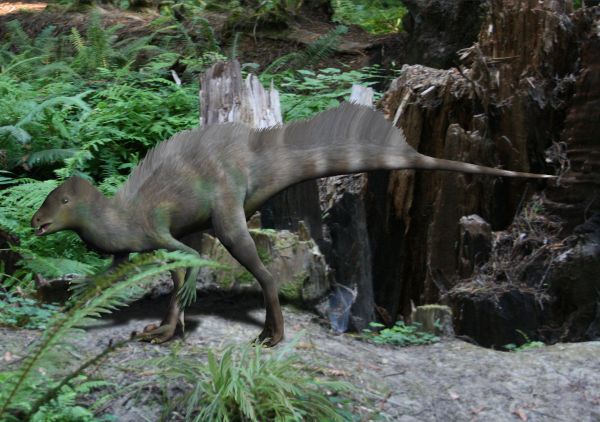
Ornithomimus
Ornithomimus means "bird mimic," and what an appropriate name that is! This genus of Cretaceous Dinosaur had long slender legs, a log neck, and a toothless beak. Think of it as an ancient Ostrich- they had similar omnivorous diets, similar body-types, and could even run at comparable speeds. They may have also been covered with feathers, but the evidence doesn't prove anything 100%.

The fist Ornithomimus fossils were uncovered in Colorado back in 1889. Who found them? Why none other than one of our Bone Wars buddies, Othniel C. Marsh! He named the genus in 1890, and since then more fossils have been located in other spots of North America, as well as in Mongolia.

Ornithomimus fed on plants, fruits, seeds, and small creatures like insects and tiny mammals. They had no teeth and very small heads so it is unlikely that they ate anything very large. Even though their heads were small, they had large brain cases. This suggests either a greater level of intelligence, or a larger brain devoted to movement and kinesthetic pursuits.

Status : Extinct for 65 million years
Location : North America, Mongolia
Size : Height up to 8ft (2.4m), length up to 20ft (6m)
Classification : Phylum : Chordata -- Class : Reptilia -- Superorder : Dinosauria
Order : Saurischia -- Family : †Ornithomimidae -- Genus : †Ornithomimus

Wednesday, March 20, 2013

Ankylosaurus

Ankylosaurus magniventris
About a week ago we learned all about an armored Sauropod, Ampelosaurus. Today we'll learn about one of the most famous armored Dinosaurs of them all- Ankylosaurus. Like Ampelosaurus, Ankylosaurus lived during the late Cretaceous period... though a few million years later and in a different part of the world.

There is only one identified species within the Ankylosaurus genus-- A. magniventris. It was first uncovered in Montana back in 1906, and officially named in 1908. Ankylosaurus translates to "Curved Lizard" or "Stiffened Lizard," while magniventris means "great belly," a reference to the animal's width.

Ankylosaurus was covered by osteoderms of varying sizes, and those plates most likely had keratin on top of them as well. They also had large, clubbed tails-- those clubs were actually osteoderms fused with the last few vertebrae on the tail. Those plates and club (and the horns on their head) made them a difficult animal for predators to take down.

Ankylosaurus was an herbivore, and had a beak and small teeth that were used to browse from trees. They actually lacked molars, so food wasn't really ground up. Overall, we know a lot about the anatomy of the Ankylosaurus... except for what its feet looked like! No foot fossils have ever been found, though based on the feet of closer relatives, they probably had five toes on each foot.

Status : Extinct for 65 million years
Location : North America
Size : Length up to 30ft (9m)
Classification : Phylum : Chordata -- Class:  Reptilia -- clade : Dinosauria
Order : †Ornithischia -- Family : †Ankylosauridae
Genus : †Ankylosaurus-- Species : †A. magniventris

Tuesday, March 12, 2013

Eocursor

Eocursor parvus
Eocursor is the name of a Dinosaur genus whose fossils were first uncovered back in 1993. It took an additional 14 years for the discovery to be properly studied and described, and the result was a creature whose name translates to "Dawn Runner."

Eocursor lived during the Late Triassic, and is an example of an early Ornithischian. In fact, this creature is the oldest found, and has the most complete skeleton of any early member of it's Order, which has helped to bring in information about the origins of the group. Until this discovery, very little was known at all about the rise of the Ornithischians (a group that includes Stegosaurus and Triceratops).

We don't have a full skeleton of Eocursor, but we do have hands, legs, a pelvis, and skull fragments. These pieces are enough to tell us that the Dinosaur walked on two feet, was a very swift runner, and probably had an omnivorous diet (which we can tell from the teeth).

There is still much to be learned about the origin and evolutionary history of all Dinosaurs, and hopefully future finds will help to fill in some of the breaks in our knowledge. Alas, the fickle nature of fossils, and the incredible environmental needs that have to be met to create them, mean that we won't be able to know it all. But even with a few bones, like the handful found for Eocursor, we can still learn a lot!

Status : Extinct for 210 million years
Location : South Africa
Size : Length around 3ft (1m)
Classification : Phylum : Chordata -- Clade : Dinosauria -- Order : †Ornithischia
Genus : †Eocursor -- Species : † E. parvus

Sunday, March 3, 2013

Eoraptor

Eoraptor lunensis
We've been learning a lot about Dinosaurs recently, though most of those lived in the Cretaceous period, not long before the big extinction event that wiped all the Dinosaurs out. Today's Dinosaur comes from the opposite end of the timeline-- it is one of the earliest known Dinosaurs, and lived nearly 230 million years ago.

Eoraptor ("Dawn Theif"), hailed from the Late Triassic. They were small, only about 3ft long in total, and walked on two legs. Their mouths were filled with teeth that could be used for both carnivorous and herbivorous diets, though their other features suggest that they leaned more towards the meat-eating side. Eoraptor also had long legs that suggest a fast moving gait, and five-fingered hands that had three long, clawed fingers, and two fingers that appear to be too small to be useful.

Eoraptor was first discovered in 1991 in Argentina, and was named in 1993. What is a dry badlands today was once a river valley, and it is in that area that the fossils were found  along with fossils of other early Dinosaurs.

We know that Eoraptor was an early Dinosaur because of the fossil location, and also because of the animal's morphology . They lacked the specialized features that appeared in later Dinosaur groups. Some think that because they are so ancient, and so non-specific in their features, that they aren't quite Dinosaurs at all. And if they are in fact Dinosaurs, as the popular opinion states, there is disagreement about whether or not they are truly Saurischian or Theropod.

Status : Extinct for 230 million years
Location : Argentina
Size : Length up to 3ft (.9m)
Classification : Phylum : Chordata -- Class : Reptilia -- clade : Dinosauria
Genus : †Eoraptor-- Species : †E. lunensis

Saturday, March 2, 2013

Ampelosaurus

Ampelosaurus atacis
Ampelosaurus is one incredible looking Dinosaur. Not only are they members of the gigantically long Sauropod group, but they also had armor on their backs!

Ampelosaurus wasn't as long, or even as long-necked as some of its Sauropod relatives, but at 50ft in length they were far from tiny. They bony plates on the back are called osteoderms, and they grow from the dermal layers of the skin. Ankylosaurus and Stegosaurus are two other Dinosaurs famous for their Osteoderms.

This Dinosaur is also pretty distinct because its fossils have been found more-or-less complete. Typically, Titanosaurs (the very large sauropods that lived in the Late Cretaceous) have to be reconstructed using only a handful of found remains. Ampelosaurus has provided us with dozens of fossils, including a skeleton that is very close to complete! They are one of the best known Dinosaurs in Europe.

Ampelosaurus ("Vineyard Lizard") lived between 70 and 65 million years ago, at the very end of the Dinosaurs' reign. They stomped around what is now Europe, and most of their fossils have been recovered from the Marnes Rouges InfĂ©rieures Formation in France. They were first uncovered near a Vineyard, hence the name's translation.

Status : Extinct for 70 million years
Location : Europe
Size : Length up to 50ft (15m)
Classification : Phylum : Chordata -- Superorder : Dinosauria -- Order : Saurischia
Infraorder : Sauropoda -- Genus : Ampelosaurus -- Species : A. atacis

Friday, February 22, 2013

Amphicoelias fragilis

We all know that the Blue Whale is the longest (and largest) living vertebrate. But is it the longest one to have ever lived? What about Dinosaurs? And what are "The Bone Wars?" Time for a story!

The year is 1877, the place- Colorado. Two paleontologists, Othniel C. Marsh and Edward Drinker Cope, had been embroiled in a paleontological battle of one-up-manship for nearly a decade. These "Bone Wars" stem back to 1868 when Marsh publicly humiliated Cope for reconstructing an Elasmosaurus incorrectly. The battle then intensified when Marsh tossed scientific decorum to the wind and bribed excavators to exclusively send him fossils from a site in New Jersey.

These underhanded actions went on well into the 1890s, as both men resorted to theft, bribery, and destruction of property in attempts to come out on top. They also strove to ruin the other's credibility and get their funding cut off. In the end, both men were ruined financially, and gave American Paleontology some pretty bad PR in the eyes of their European counterparts.

Cope's A. fragilis vertebrae drawing
However, the competition was pretty good for discovery, as they did end up identifying almost 140 new species of Dinosaur in the process. (If you  had to pick a winner, it would probably be Marsh. In the end he simply had more money and was able to hire larger crews, thus enabling him to discover 80 new species, compared to Cope's 56) These two rivals were responsible for the discovery of some of the most famous Dinosaur types. Triceratops, Stegosaurus, and Diplodocus were all finds that can be attributed to the Bone Wars.

But.... they were also responsible for some pretty big screw ups. The whole Brontosaurus/Apatosaurus confusion? Marsh. And what about today's animal? Amphicoelias fragilis? That one is all Cope.

You see, back in 1877 there were some huge digs going on in the American west. Rich fossil sites with dozens of undiscovered species were being fought over by the two men. During this time an absolutely massive vertebrae was uncovered, measuring 5 feet by 9 feet. A creature would have had to measure nearly 200ft long in order to have a bone that size! That would make this Sauropod the longest vertebrate to have ever lived!

...But Cope screwed up somewhere. Because the bone was lost not long after it's uncovering. The only evidence we have are notes and drawings made by Cope. Did he exaggerate? Was there a clerical error? No one really knows, and so Amphicoelias fragilis remains an asterisk on the "Longest-Creatures" list, pending additional fossil evidence.

Status : Extinct
Location : United States
Size : Length up to 200ft? (61m)
Classification : Phylum : Chordata -- Class : Reptilia -- Order : Saurischia
Superfamily : †Diplodocoidea -- Genus : †Amphicoelias -- Species : A fragilis

Saturday, February 16, 2013

Fruitadens

Fruitadens haagarorum
Allow me to introduce you to a tiny little Dinosaur named Fruitadens. They are the smallest discovered members of the entire Ornithischian (bird-hipped) Order. These tiny guys only measured 2ft in length, and weighed less than 2lbs!

Fruitadens are not, in fact, named "Fruit Tooth." The moniker actually comes from the Fruita region of Colorado, which is where their fossils were discovered. Confusing the issue even more is the fact that they little guys probably did eat fruit... but they also ate small critters, insects, and other plants as well. It seems that they were very opportunistic feeders.

Fruitadens was first described only 2 years ago, but the bones where uncovered back in the 1970s and 1980s! They sat stored at the Los Angeles County Museum for decades until a more exact study could be done. The resulting analysis turned up one species, Fruitadens haagarorum (named for the President of the Museum's Board of Trustees), which lived during the Late Jurassic.

Status : Extinct since the Late Jurassic - 150 million years ago
Location : Colorado
Size : Length up to 30in (76cm), Weight up to 1.7lbs (.7kg
Classification : Phylum : Chordata -- Class : Reptilia -- Order : †Ornithischia
Family : †Heterodontosauridae -- Genus : †Fruitadens -- Species : †F. haagarorum

Saturday, January 19, 2013

Kentrosaurus

Kentrosaurus aethiopicus
Meet the Kentrosaurus, a member of the Stegosaurus family whose fossils have been found exclusively in the African country of Tanzania.

Kentrosaurus lived during the Late Jurassic, between 155 and 150 million years ago. They were smaller members of the Stegosauridae family, and only measured around 15ft from head to tail. Kentrosaurus had hind legs that were longer than their front legs, which means they fed primarily on low lying vegetation. These Dinosaurs were herbivores, possibly traveled in herds, and were most likely not very intelligent (very small brain size compared to body size).

This Dinosaur had a double row of bony plates that ran from the head to the mid back. No one is especially sure what the plates were used for-- temperature control and for mating displays are two theories. Where the plates end, a double row of long spikes begins. There were most likely used for defensive purposes. The name "Kentrosaurus" is actually inspired by those spikes-- Kentron is Greek for "point" or "prickle."

I can't talk about Kentrosaurus without mentioning some of the history surrounding their discovery. The first fossils were uncovered by a German team in 1909, and over the following years around 1,200 bones were dug up and sent back to Germany. Unfortunately, many of these bones (around 70%!) were destroyed during World War II. All of the remaining material is located in Berlin and Tubingen, so if you are interested in checking out some Kentrosaurus fossils, you know where to go!

Status : Extinct since the Late Jurassic, around 150 million years
Location : Found in Tanzania
Size : Length around 15ft (4.5m)
Classification : Phylum : Chordata -- Class : Reptilia -- Order : †Ornithischia
Family : †Stegosauridae -- Genus : †Kentrosaurus -- Species : †K. aethiopicus

Thursday, January 3, 2013

Shuvuuia

Shuvuuia deserti
Meet Shuvuuia, a small Cretaceous Dinosaur that was most likely covered in a coat of feathers! The type fossil of the species was found with many deteriorated structures surrounding it, structures that were similar to the central shafts of modern bird feathers. Further analysis showed that these structures once contained beta-keratin, but not alpha-keratin, which gives further evidence towards a feathery coat (as only bird feathers have beta-keratin, but not alpha).

Aside from the feathers, Shuvuuia had a few other bird-like traits. Their skulls, legs, and feet were all very similar to those on birds, but their arms are not, leaving them still within the realm of the Dinosaurs.

Shuvuuia even has a bird name, literally! Their genus is named for the Mongolia word for bird, shuvuu, as the fossils were found in Mongolia. Shuvuuia dates back between 85 and 75 million years, putting it in the Late Cretaceous period.

These Dinosaurs were very small, standing only a foot or so high and having a full body length of 2-3ft. They probably ate insects and small mammals, and were most likely very quick on their feet. All that we know about Shuvuuia comes from only a few fossils, so there is still very much to be learned and uncovered!

Status : Extinct for around 75 million years
Location : Mongolia
Size : Length up to 2ft (60cm)
Classification : Phylum : Chordata -- Class : Reptilia -- clade : Dinosauria
Family : †Alvarezsauridae -- Genus : †Shuvuuia-- Species : †S. deserti

Tuesday, January 1, 2013

Albertosaurus

Albertosaurus
Albertosaurus is a Cretaceous carnivore named for the Canadian province of its discovery It was first discovered by J.B. Tyrell  in 1884, and was officially identified as a species in 1905.

As a member of the family Tyrannosauridae, Albertosaurus is a relative to the T. Rex. They share many physical similarities, including a large skull, small forelimbs, and powerful hind legs. Albertosaurus, however, was smaller than the T. Rex, and predated it by a few million years. They were probably very fast runners, and could recovered from stumbles and falls easier than their larger relatives.

Skull Cast
Albertosaurus had quite a few teeth. 14-16 on the lower jaw, and 17-19 on the upper. Though they had only one row of teeth at a given time, there was always a replacement growing in the jaw in case a tooth fell out!

We actually know quite a bit about the Albertosaurus, as there have been fossils of over 30 different individuals discovered. Not only are there numerous fossils, but the individuals that they represent span a large age range. That, combined with the fact that many of the fossils were found on one site, suggests that the Albertosaurus lived in large pack groups.

There is a little bit of confusion surrounding the species within the Albertosaurus genus. A. sarcophagus has long been considered the type species, but for a long time a second species A. libratus was also classified with the genus. Studies have been done to determine whether these two Dinosaurs belong so closely related, and now there are many who have changed A. libratus  to Gorgosaurus libratus.

Status : Extinct for 70 million years
Location : Western North America
Size : Length up to 33ft (10m), Weight up to 5,500lbs (2,500kg)
Classification : Phylum : Chordata -- Class : Reptilia -- Order : Saurischia
Family : †Tyrannosauridae -- Genus : †Albertosaurus -- Species : A. sarcophagus