Showing posts with label Rodent. Show all posts

Friday, March 15, 2013

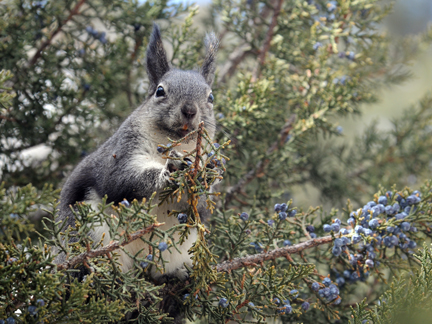
Abert's Squirrel

Sciurus aberti
Abert’s Squirrels are adorable little dudes that are sometimes referred to as Tassel-Eared Squirrels (guess why). Their are nine recognized subspecies that vary in coloration and location, but most sport grey-brown coats and white underbellies.

 They live in the coniferous forests of western North America, and have a rather interesting relationship with the Ponderosa Pine tree. You see, unlike some plant-animal relationships (I’m looking at you Maned Wolf / Lobeira), the one between the Squirrel and Pine is not a perfect one for all parties involved. The Squirrels use the trees for shelter and food, but the Pines don’t really want them there, despite the fact that the Squirrels help to spread beneficial fungi to the Pines.

Abert's Squirrel
The Ponderosas that live in especially Squirrely areas secret extra chemicals to keep the critters away, and the Squirrels search for less toxic Ponderosa’s to live and feed on. Unfortunately, the Pines with higher chemical secretions have lower vitality and growth rates. It’s definitely a weird relationship!

Abert’s Squirrels are also interesting in that they don’t store food like many other Squirrels do. Rather than stash food, hibernate, and then find it all again in spring, these Squirrels are active year round and have no reason to hide their meals.

IUCN Status : Least Concern
Location : North America
Size : Body Length up to 23in (58cm)
Classification : Phylum : Chordata -- Class : Mammalia -- Order : Rodentia
Family : Sciuridae -- Genus : Sciurus  -- Species : S. aberti

Wednesday, March 13, 2013

Greater Long-tailed Hamster

Tscherskia triton
Did you know that there are literally dozens of species of Hamsters, not just the ones that we keep as pets? Today's animal is one of the wild ones. It is considered to be a "Rat-like Hamster" and is actually considered to be quite the nuisance!

Meet the Greater Long-tailed Hamster, a rodent species that is found in China, North and South Korea, and parts of eastern Russia. They live in open areas near water, including grasslands, marshlands, and agricultural fields. The Hamsters that live near crops and rice fields are considered to be pests, as they will eagerly go after the grains and seeds. All members of the species, regardless of what they eat, stockpile food for the winter, sometimes up to 20lbs of it!

Greater Long-tailed Hamsters have a very short lifespan-- only about a year. But during that year they do their very best to carry on their genetic line. They can produce three litters of up to 10 offspring in only a few months time!

IUCN Status : Least Concern
Location : East Asia
Size : Weight up to 185g
Classification : Phylum : Chordata -- Class : Mammalia -- Order : Rodentia
Family : Cricetidae -- Genus : Tscherskia -- Species : T. triton

Sunday, March 10, 2013

Delicate Mouse

Mus tenellus
Today's creature is one of those animals that not very much is written about. Maybe it is due to their small size? Maybe specific mouse species just aren't distinguishable enough from one another? Well, we're going to try and learn as much about the Delicate Mouse as possible anyway (though it may not be much). Because who couldn't be interested in a tiny creature with a name like that?

The Delicate Mouse is one of many, many species found within the Mus genus. What makes them (sort of) stand out is their location-- Mice are divided into five different location-based subgenera, and the Delicate Mice belong to the group that is exclusively found in Sub-Saharan Africa. They have been recorded in Somalia, Kenya, Tanzania, Sudan, and Ethiopia, and were first described in 1903.

Within their range, the Delicate Mice live in dry savanna habitats that are at low elevations. They feed on different grains and grasses, and they themselves serve as prey for an absolute plethora of predators, including snakes, birds of prey, and a wide range of mammals.

Their are no major threats affecting the Delicate Mice, and they are common throughout their range. Their population is presently considered to be stable, though it is unknown how adaptable they will be should they encounter increased habitat loss.

IUCN Status : Least Concern
Location : Sub-Saharan Africa
Size : Length around 9cm
Classification : Phylum : Chordata -- Class : Mammalia -- Order : Rodentia
Family : Muridae -- Genus : Mus -- Species : M. tenellus

Giant Beaver

Giant Beaver at the Field Museum
So today lets learn about the largest Ice Age rodent: the Giant Beaver. These massive creatures could grow over 8ft long! Based on their skeletal structure, we can assume that they looked very much like modern Beavers, only on a greater scale. To give some perspective on how large Giant Beavers were, they would be about the same size as a Black Bear!

Reconstruction at the Kenosha Public Museum
Giant Beavers lived in North America during the last Ice Age, and went extinct around 10,000 years ago, along with many of the other megafauna species. While human movement into North America may have played  a part in the extinction of other creatures, there has been no found evidence yet that Giant Beavers were hunted by man.

Giant Beavers and modern Beavers share many similarities. They both build lodges and they both live a semi-aquatic lifestyle. However, Giant Beavers had broader teeth than their cousins, and they were rounded rather then chiseled. They also had shorter legs, larger hind feet, and a longer tail (proportionally, of course). This suggests that they may have had difficultly moving on land, making them an even more aquatic species.

Habitat reduction and competition with modern Beavers may have led to the demise of this gigantic species, much like many of the other Ice Age giants.

Status : Extinct for 10,000 years
Location : North America
Size : Body length up to 8.2ft (2.5m), Weight up to 220lbs (100kg)
Classification : Phylum : Chordata -- Class : Mammalia -- Order : Rodentia
Family : Castoridae -- Genus : †Castoroides -- Species : †C. ohioensis

Thursday, March 7, 2013

Indian Palm Squirrel

Funambulus palmarum
Indian Palm Squirrels are also sometimes referred to as Three-Striped Palm Squirrels, due to the patterning on their backs. They are found as a native species in India and Sri Lanka, and were intoduced to Australia where they have become quite the nuisance.

Did you know that the Indian Palm Squirrel has it's own Hindu legend? According to the story, a bridge was being built by Lord Rama, and a small squirrel decided to help by carrying small rocks and pebbles, all the while chanting Rama's name. He was so impressed by the contribution of this tiny animal that he stroked her back, leaving stripes where his fingers would've touched.

Indian Palm Squirrels are a very adaptable, and are able to live in a variety of habitats. Unsurprisingly, they have taken to urban areas just as well as wild ones. They eat fruits, nuts, insects, and eggs.

As previously mentioned, Indian Palm Squirrels have become an invasive species in Australia. They consume crops, eat the eggs of native birds, and have few natural predators. It is illegal to import, possess, or sell them within the country.

IUCN Status : Least Concern
Location : Indian, Australia (introduced)
Size : Length up to 8in (20cm)
Classification : Phylum : Chordata -- Class : Mammalia -- Order : Rodentia
Family : Sciuridae -- Genus : Funambulus-- Species : F. palmarum

Friday, March 1, 2013

Mountain Beaver

Aplodontia rufa
We've all heard about the American and European Beavers, the large rodents that use their exceptional engineering skills to dam up and control watery ecosystems. But have you heard about the Mountain Beaver? Yes! This is a real animal! They live in the Pacific Northwest and are incredibly elusive. And they aren't even really Beavers!

Despite what the common name might suggest, Mountain Beavers don't always live in the mountains. They live in the coastal forests of British Columbia, Oregon, Washington, and California. They are called Beavers because they chew at bark just like their larger, distant cousins.

Mountain Beavers are considered to be the world's most primitive living rodents. They are the only members of their genus and family, and can be traced back 40 million years. Ready for another weird fact? Mountain Beavers are host to the world's largest flea which measures .3in long!

The Mountain Beaver population is healthy, and the animals are active little herbivores year round. However, they do live in extensive underground burrows and are rarely seen. With their underground lifestyle, elusive habits, and interesting back-story, it's no wonder many people think their a myth right up there with the Jackalope!

IUCN Status : Least Concern
Location : Western North America
Size : Body Length up to 20in (50cm)
Classification : Phylum : Chordata -- Class : Mammalia -- Order : Rodentia
Family : Aplodontiidae -- Genus : Aplodontia -- Species : A. rufa

Sunday, February 24, 2013

Long-eared Jerboa

Euchoreutes nas
The Long-eared Jerboa is a really crazy looking little rodent, mostly because its titular ears are actually 1/3 larger than its head. They have one of the largest ear to head ratios of any mammal! It also, like other members of its family, has very long hind legs and a long tail that help them to move about and give them traction in desert habitats.

Long-eared Jerboas are both the only member of thier genus, and the only member of their Subfamily, making them genetically distinct among rodents. However, their small size and nocturnal habits have made them very difficult to locate and study. In fact, they were only first caught on camera in 2007!

We don't know a whole lot about this tiny creature, unfortunately. But we do know that they are nocturnal, spend the daytime in burrows, and are herbivores.

Habitat loss and human disturbance are thought to pose a risk to the Long-eared Jerboas, but they can now be found in many protected areas, and their are no specific conservation measures for the species.

IUCN Status : Least Concern
Location : China and Mongolia
Size : Body length 2.8in (7cm)
Classification : Phylum : Chordata -- Class : Mammalia -- Order : Rodentia
Family : Dipodidae -- Genus : Euchoreutes -- Species : E. naso

Wednesday, February 13, 2013

Utah Prairie Dog

Cynomys parvidens
There are five different species of Prairie Dog, with the Utah being the smallest. They also happen to be one of the most rare, and are listed as Endangered. They have cinnamon colored backs, white tails, and brown spots above and below the eyes.

Unsurprisingly, the Utah Prairie Dog is found only within the State of Utah. They, like all Prairie Dogs, are members of the Squirrel family, and they are most closely related to the White-tailed Prairie Dog. The two species may have once been a single species way back when, though they are now separate and live in different ranges (the White-tailed lives further north and east).

Utah Prairie Dogs build extensive underground burrows, and their large extended families live together within them. They live in these "towns" year round, and remain in them exclusively in the winter, though they don't take part in a true hibernation process. Utah Prairie Dogs are primarily herbivores, preferring to feed on flowers and seeds, but they will eat grasses when necessary, and will also grab the occasional insect.

The Utah Prarie Dog is considered Endangered because their population went on a large decline due to habitat loss and intentional killing. They were causing damage to crops and farmland, which led to shootings and poisonings that decimated populations. Since the 1970s, efforts have been made to move colonies from private to public land, but nearly 70% of the Prairie Dogs still live in unprotected private areas. The population is still on the decline, and it is estimated that there are around 10,000 left.

IUCN Status : Endangered
Location : Utah, United States
Size : Length up to 14in (36cm)
Classification : Phylum : Chordata -- Class : Mammalia -- Order : Rodentia
Family : Sciuridae -- Genus : Cynomys -- Species : C. parvidens

Sunday, February 10, 2013

Nutria

Myocastor coypus
What is this weird, beaver/rat looking Rodent? Why, it is the Nutria! Sometimes also referred to as the Coypu.
These guys are native to South America, where they live near bodies of water and feed on the aquatic plants.

Nutria often live in colonies where they breed at very quick rates. A female may have 2 or 3 litters a year, with each litter producing as many as 13 offspring! The young Nutria leave their mother after only a month or two. They are a short lived and very quick growing species. Male Nutria can reach sexual maturity at four months of age, and they tend to live for only a few years.

Outside of their natives lands, Nutria are very, very destructive. See that shaggy, not especially appealing coat? Well under that is a very dense undercoat that has long been used in the fur industry. The desire for these pelts resulted in the growth of captive breeding fur farms... that the Nutria occasionally escaped from.

The species is now considered invasive in several US states, as well as in parts of Europe, Africa, and Asia. They are destructive because they breed quickly and feed on wetland plants, but care only for the stems. This means that they consume huge amounts of vegetation with much of it going to waste. The loss of vegetation leads to more erosion and soil displacement, which damages the wetlands. Nutria also carry parasites and displace native species. Hunting and chemical control methods are attempting to cut down the invasive populations, but only time will tell.

IUCN Status : Least Concern
Location : South America
Size : Body Length up to 2ft (60cm), Weight up to 20lbs (9kg)
Classification : Phylum : Chordata -- Class : Mammalia -- Order : Rodentia
Family : Myocastoridae -- Genus : Myocastor -- Species : M. coypus

Tuesday, February 5, 2013

Alpine Marmot

Marmota marmota
It's been a while since we last talked about a Marmot- those big old Ground Squirrels that tend to produce some hilarious photographs. Today's Marmot is the largest of the clan, which also makes it the largest of all the world's Squirrels as well!

Alpine Marmots are found (where else?) in the European Alps. Though I should also note that they have been introduced to the Pyrenees, the Carpathians, the Tatras, and a few other areas as well. Grassy, high-altitude plains are their preferred habitats, as they allow them to build the complex burrows systems that they live in, and to feed on the grasses and flowers that they prefer.

Marmot families are pretty close knit, are are comprised of a breeding pair and their offspring from previous years. They can number as few as 3-5 individuals, or as large as 50! There is some interbreeding within these colonies, but it is minimal as these colonies are typically female dominant, so the males only remain in a colony for a year or two (Alpine marmots can live as long as 14 years!)
Alpine Marmot

The Marmot colonies spend their active months foraging for food and preparing for their winter hibernation. They use a variety of calls and whistlers to warm one another against danger during these foraging sessions.

Did you know that these guys hibernate for half of the year? When winter comes they head into their burrow system, and the last one in plugs up the hole with grasses and dirt to keep out the cold. Infant mortality is pretty high in Marmots, so snuggling with the youngsters and keeping them warm greatly increases their chances of living another year.


IUCN Status : Least Concern
Location : Europe
Size : Body Length up to 21in (54cm), Weight up to 17lbs (8kg)
Classification : Phylum : Chordata -- Class : Mammalia -- Order : Rodentia
Family : Sciuridae -- Genus : Marmota -- Species : M. marmota

Monday, February 4, 2013

Degu

Octodon degus
For the last decade or so I've kept Degus, but that came to an end this weekend when my last girl passed away. For some reason I hadn't written about these neat little rodents before, so now seems like the fitting time to do it.

When people heard about my ownership of these animals, their first response was always "What the heck is a Degu?" And I don't really blame them. Before I stumbled upon the breeder of my first girl, I really didn't have a clue either. (Note, Don't impulse buy! I went home and read all about them before I made any decisions!)

Degus love to sleep in piles
Degus are small rodents that are native to central Chile, and they share a family with several species of Viscacha Rat. They are also relatives to Chinchillas and Guinea Pigs. The picture there doesn't do a whole lot of good, but they can grow up to a foot long, including the tail.

All Degus are incredibly social animals. In the wild they can live in huge community burrows, and in captivity they are best kept in multiples. They are diurnal and are exclusively herbivorous, browsing on seeds and leaves.

One of the most bizarre things about Degus is their diet. Due to evolving in an area without much access to sugar, Degus can not ingest dietary sugars without running a a huge risk of developing Diabetes. Captive Degus must be fed foods that are free of sugary treats, which was actually pretty difficult to do when I first started out with the species. Honey, Molasses, and Glucose Syrup are all commonly found in small animal pellets, though thankfully now there are a number of food manufacturers that create food specifically for a Degu's needs.

Due to their strange diet, and also to their intelligence, Degus have been used as lab animals in studies that deal with Diabetes, hand-eye coordination, and Circadian Rhythms. Their popularity as lab animals eventually led to their introduction into the pet industry, though they are still pretty rare and hard to find.

Degus are very intelligent, posses some great problem solving skills, and have unique personalities. Mine could recognize different people and voices, and had different attitudes towards certain snacks, being held, and their reactions to larger animals. (One actually took an interest in the cats and dogs she lived with, and would not be afraid to bark at them if they got too close to her cage)

They also have a lifespan that surpasses that of most small animals. 6-8 years is not uncommon, and some can live far longer that that! Degus do require that special diet that we talked about, and are suceptible to a handful of different diseases. They love to climb and stay active... and they also love to chew, so all cages should be large and have metal bottoms to them so that they don't escape. And, like Chinchillas, they need regular dust baths to keep their coats nice and clean.

IUCN Status : Least Concern
Location : Chile
Size : Length up to 12in (30cm)
Classification : Phylum : Chordata -- Class : Mammalia -- Order : Rodentia
Family : Octodontidae -- Genus : Octodon -- Species : O. degus

Tuesday, January 29, 2013

Tasmanian Mock Walrus


Why not spend April Fools learning about an animal that doesn't even exist? Meet the Tasmanian Mock Walrus, a hoax animal that caused quite a bit of confusion way back on Aprils Fools Days, 1984.

As a joke, the Orlando Sentinel ran a story about the Tasmanian Mock Walrus, a 4in long creature that was the absolute perfect pet! It looked like a tiny Walrus! It could be littler box trained! It purrs like a cat and can even keep your house Cockroach free!

The story even contained a photo of one of the little guys, who were being bred in the United States for the first time by a couple down in Florida. Allegedly, the Pest Control industry was harassing this couple, as they were afraid they would lose business because of these new miracle pets!

So what was the little animal behind the newspaper prank? Just a regular old Naked Mole Rat. The story resulted in a flood of calls and letters to both the newspaper, and to Florida pet stores. It even made its way around the world! The demand was quite high for a creature that was completely made up!

Friday, January 25, 2013

Cape Porcupine

Hystrix africaeaustralis
Allow me to introduce you to the largest Porcupine in the world, and the largest Rodent on the African Continent-- the Cape Porcupine. They shiny critters can grow almost 3ft long (not including the tail), and individuals have been found that weigh over 60lbs!

Though the name hints at a specific location, the Cape Porcupine can actually be found throughout central and southern Africa. They live at elevations below 2,000m, and can be found in a large range of habitats, though they prefer open, rocky areas.

Obviously, Cape Porcupines have quills. Their back and tail is covered with them, and the ones in the tail are  especially hollow. This allows the Porcupine to make a rattling sound in order to scare off predators. If that tactic fails, the Porcupine will charge at its attacker and try and stab them with their quills. Contrary to popular belief, they do not shoot the spines out-- they stab and then dislodge them.

Cape Porcupines are rodents that mate for life. Monogamous pairs will live and raise their young together, and will mark and defend a specific home range. They are also a nocturnal species, and are herbivores. The Porcupines  typically eat fruits, bark, and roots, but will also go after crops. They are considered to be a pest in some places, do to crop and tree damage.

Cape Porcupines have a stable population and are not under any major conservation threat.

IUCN Status : Least Concern
Location : Southern and Central Africa
Size : Body Length up to 32in (80cm), Weight up to 53lbs (24kg)
Classification : Phylum : Chordata -- Class : Mammalia -- Order : Rodentia
Family : Hystricidae -- Genus : Hystrix-- Species : H. africaeaustralis

Grizzled Giant Squirrel

Ratufa macroura
The Grizzled Giant Squirrel is a threatened species that is found in only a few spots of India and Sri Lanka. There are three different subspecies, and as a whole they are the smallest of the Indian Giant Squirrels.

Grizzled Giant Squirrels are named for the white flecks of hair that cover their greyish-brown bodies, giving them a grizzled look. They also have very long tails that can constitute over half their total body length, and small round ears with tufts.

Though there are Squirrels that live on the ground (I'm looking at you Marmots), this particular species lives just about exclusively in the trees. Their long tails make them great jumpers, and they can leap as far as 6m between trees! Grizzled Giant Squirrels are very territorial, and usually live alone or in pairs. They forage during the daytime, searching for fruits, nuts, insects, and even bird eggs. Pairs produce one little a year, number 1-2 offpsring.

Unfortunately, the Grizzled Giant Squirrels is listed as Near Threatened. They are hunted by humans for meat and fur, and habitat degradation has made them either lose their homes entirely, or live in thinned out forests where they are easier to spot by avian predators. They are protected in a few places, most notably the Shenbagathope Grizzled Squirrel Sanctuary in Southern India.

IUCN Status : Near Threatened
Location : India, Sri Lanka
Size :  Total length up to 35in (90cm)
Classification : Phylum : Chordata -- Class : Mammalia -- Order : Rodentia
Family : Sciuridae -- Genus : Ratufa -- Species : R. macroura

Thursday, January 24, 2013

Syrian Hamster

Mesocricetus auratus
Today's animal may look familiar, as they are one of the most popular small animals kept as pets. But did you know that in the wild Syrian Hamsters are becoming quite rare?

Syrian Hamsters were first identified in the early 19th century, and were first utilized as lab animals due to their ability to breed more readily. In fact, it is believed that all captive Hamsters in North America are descended from one litter that was captured and used for research in the 1930s.

In the 1940s Syrian Hamsters entered the pet world, and there are now over 40 varieties. They come in long and short haired versions, and in a massive number of color combinations. They are the most common hamsters kept as pets.

So is Syrian Hamsters are so popular as pets, why are they so Vulnerable in the wild? There are actually a numbers of factors. The first is that their range is very small. Less than 7,500 square miles (around 20,000 square km). Secondly, they are losing that small area to habitat encroachment. And third, they are considered to be agricultural pests, and are often baited by farmers. There are currently no conservation measures taking place throughout their native range.

IUCN Status : Vulnerable
Location : Syria
Size : Body Length up to 6in (15.5cm)
Classification : Phylum : Chordata -- Class : Mammalia -- Order : Rodentia
Family : Cricetidae -- Genus : Mesocricetus -- Species : M. auratus

Monday, January 21, 2013

Neotropical Pygmy Squirrel

Sciurillus pusillus
The Neotropical Pygmy Squirrel is an animal that really intrigues me... because I know almost nothing about it. There is actually so little recorded about these rodents that they are listed as "Data Deficient" by the IUCN. It is even difficult finding pictures of them!

Neotropical Pygmy Squirrels are the smallest of all the South American Squirrels, weighing as little as 40g. (For comparison, the Western Grey Squirrel of North American can weigh ten times that much!) They have a patchy distribution in the lowland rainforests of Brazil, Colombia, Peru, and nearby areas.

Their small sizes means that we don't see them very often, and only recently have them become subjects of study (but there is still so, so much to learn!) We have learned that they are monotypic for their subfamily, that they have very small littler sizes (no more than 2), and they probably feed on the barks, gums, mosses, and insects and grow/live in the trees.

Hopefully more studies and observations will be done in the future, so that we can learn even more about this tiny little Squirrel!

IUCN Status : Data Deficient
Location : South America
Size : Body length up to 10cm, Weight up to 43g
Classification : Phylum : Chordata -- Class : Mammalia -- Order : Rodentia
Family : Sciuridae -- Genus : Sciurillus-- Species : S. pusillus

Friday, January 18, 2013

Australian Swamp Rat

Rattus lutreolus
The Australian Swamp Rat is a species that is common throughout its range in south and eastern Australia. They prefer areas of dense vegetation that may or may not be swamp related, so don't let the name fool you! They need for vegetation is twofold; Swamp Rats needs to hide from predators (they even cut complex tunnels in the vegetation!), and the females need enough food to have the energy to reproduce.

Speaking of reproducing... The Australian Swamp Rat breeding season can last the entire year, though spring to autumn is more common. The gestation period lasts only 3-4 weeks, and a female can produce multiple litters during a single season.

And did you know that a female rat born at the beginning of the season can herself breed by the end of it? They reach sexual maturity after less than 3 months, and only have a life expectancy of around 18 months.

Australian Swamp Rats are both nocturnal and diurnal (basically they feed when they want), and they are herbivores that dine on seeds and grasses.

IUCN Status : Least Concern
Location : Australia
Size : Body Length up to 8in (20cm)
Classification : Phylum : Chordata -- Class : Mammalia -- Order : Rodentia
Family : Muridae -- Genus : Rattus -- Species : R. lutreolus