Showing posts with label Arthropod. Show all posts

Friday, March 29, 2013

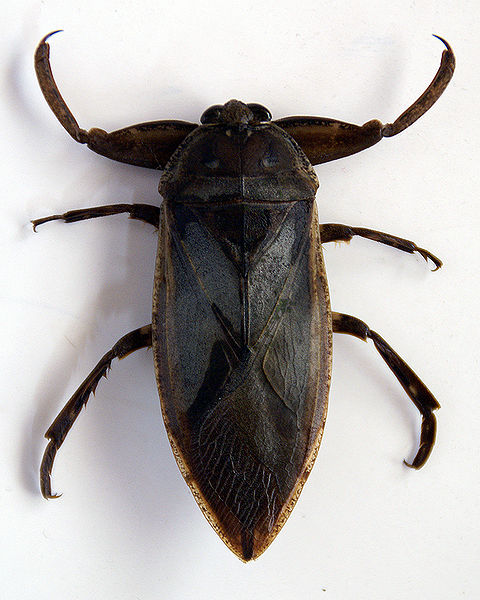
Giant Water Bug

Lethocerus sp.
Today we'll be talking about an entire taxonomic family-- Belostomitidae. Insects within this group are more commonly referred to as Giant Water Bugs. There are around 160 different species, organized into nine different genera.

The "Giant" name is certainly apt, as some members (especially those in the genus Lethocerus) can reach lengths of several inches. Even the smallest group members are a few centimeters in length.

Giant Water Bugs can be found all over the world, and are most concentrated in the Americas and in South Asia and Australia. All of the insects, regardless of continent, live in ponds and other shallow bodies of water. They spend most of their time in the water, but they must surface for air, as they do require it to breathe. Respiration takes place thanks to two appendages that extend from the abdomen. Speaking of abdomens, the eggs of two of the genera, Abedus and Belostoma, are deposited on the backs of the males, who carry them around for a week or two until they hatch!

Giant Water Bugs are amazingly little predators. They ambush hunt other bugs, small crustaceans, and even fish, birds, and amphibians! They strike, biting down with their powerful mandible and injecting a digestive saliva that liquefies the insides of their prey. Once that process has taken place, the Water Bugs can slurp up their meals. These bites can be very, very painful to humans, but are not dangerous overall.

Final fun fact of the day-- Giant Water Bugs are considered a culinary delicacy in some parts of the world. They are eaten both raw and prepared!

IUCN Status : Not Listed
Location : Worldwide
Size : Length up to 12cm
Classification : Phylum : Arthropoda -- Class : Insecta -- Order : Hemiptera
Family : Belostomatidae

Tree Cricket

Tree Cricket
Today we'll be learning about a whole bunch of different animals-- the members of the Subfamily Oecanthinae. More commonly referred to as "Tree Crickets," these insects can be found on every single continent, except for Antarctica.

Tree Crickets have two pairs of wings, and powerful hind legs for jumping. Their coloration depends on the species and habitat, but they are always well camouflaged. Some come in green shades, while others are more brown, to match either the shrubs, bushes, trees, or grasses that they live in.

These Crickets, as with many other insects, make their calls by rubbing their wing tips together. Only males can make these loud calls, female are unable.

One really interesting feature of the Tree Cricket is that they practice something called "Courtship Feeding." After mating, the male produces a fluid that is taken by the female. It is full of nutrients and helps the female to successfully reproduce. She will lay the eggs in small holes drilled into tree bark. And though they are deposited in the fall, they will not hatch until spring. The young Crickets will struggle to get out of their egg cases, and will feed on tiny insects like aphids in order to grow. Depending on the species, it can take between 5 and 12 molts for them to reach adulthood.

IUCN Status : Not Listed
Location : Every Continent but Antarctica
Classification : Phylum : Arthropoda -- Class : Insecta -- Order : Orthoptera
Family : Gryllidae -- Subfamily : Oecanthinae

Saturday, March 23, 2013

Six-spot Burnet Moth

Zygaena filipendulae
Today's animal is a small, colorful insect with a name that describes it pretty much to the tee. The six-spot Burnet Moth does in fact have six spots on each wing... though sometimes they get a bit merged together, which can result in some spot-count confusion.

Six-spot Burnets live throughout Europe and are incredibly common on the continent. There are over 20 different subspecies! Most of the subspecies have dark bodies with wings of a metallic sheen. The wing spots are red, which warns predators that these Moths are poisonous! Sometimes the spots are yellow or brown, but only rarely.

Six-spot Burnets are active during the day, when they live in colonies and feed on the nectar of large flowers. They prefer sunny days, and fly from June to August. The Moths only reproduce once, and the caterpillars overwinter before pupating and becoming Moths in June. (Sometimes they will even overwinter twice!) Caterpillars are very plump and greenish-yellow, with black spots.

IUCN Status : Not Listed
Location : Europe
Size : Wingspan up to 1.6in (4cm)
Classification : Phylum : Arthropoda -- Class : Insecta -- Order : Lepidoptera
Family : Zygaenidae -- Genus : Zygaena -- Species : Z. filipendulae

Friday, March 22, 2013

Red Flour Beetle

Tribolium castaneum
Today's animal is quite the pest; they are destructive as both larvae and adults, and though they originated in the Indo-Australian tropical regions, they can be found causing damage all around the world!

One little interesting fact is that the Red Flour Beetle is very similar in size, appearance, and behavior to the Confused Flour Beetle from Africa. The latter actually got its name because the two species were so alike!

Despite the name, Red Flour Beetles can be found in more than just flour. They hang out in cereals, nuts, seeds, and all sorts of other dried food products. They don't cause structural damage, and they don't have stingers that harm people, but they can have a huge negative impact on stored food. The Beetles even lay their eggs in food, the larvae eat the food, and the adults can live as long as 3 years.

Red Flour Beetles are very small, and very hardy. This makes it difficult to truly get rid of them. You have to completely eradicate all infested materials, check all possible cracks and crevasses, and essentially set up a sealed, protected food storage system. Pesticides and bleaches don't do a whole lot; a thorough disposal of materials is your best bet.

IUCN Status : Not Listed
Location : Worldwide
Size : Body Length less than 1cm
Classification : Phylum : Arthropoda -- Class : Insecta -- Order : Coleoptera
Family : Tenebrionidae -- Genus : Tribolium -- Species : T. castaneum

Meganeura

Way back, 300 million years back, there was a lot more Oxygen in the air than there is now. The reason for this is that plants essentially exploded on to the scene, taking in large amounts of Carbon Dioxide and expelling huge quantities of Oxygen in return. But while plants were covering the earth, animals, especially large Oxygen sucking land animals, just weren't there yet. This led to higher Oxygen percentages (around 32%, as compared to today's 21%).
Model of Meganeura

And what happens when you have higher Oxygen percentages? Larger bugs! Insects have a tracheal breathing system, which means that they take in all of their air through tracheae in their skin. This further means they can only grow as large as they amount of Oxygen they can take in. More Oxygen = larger sizes.

Meganeura was an example of one of the giants that popped up during this time. It was an absolutely gigantic dragonfly, with a wingspan of over 2.5ft! In comparison, the largest dragonfly today measures in at only 7.5in! Meganeura monyi, one of three uncovered species, is the largest flying insect species ever found.

Like modern Dragonflies, Meganeura was a predator. It fed on other insects and arthropods, as well as small amphibious vertebrates. Keep in mind though that Meganeura is only the largest flying arthropod. Other massive invertebrates crawled about during time (I'm looking at you Arthropleura), which means that this huge critter may have been hunting things even larger than itself! 

The entire Order that Meganeura belonged to is now extinct, due to the climate and evolutionary changes that led to a decrease in atmospheric Oxygen. Fossilized specimens have been found in England and France.

Status : Extinct since the Carboniferous Period, around 300 million years ago
Location : Europe
Size : Wingspan up to 2.5ft (75cm)
Classification : Phylum : Arthropoda -- Class : Insecta -- Order : †Meganisoptera
Family : †Meganeuridae -- Genus : †Meganeura

Tuesday, March 19, 2013

Common Earwig

Forficula auricularia
The Common Earwig is also called the European Earwig, but that name is a little bit misleading. Though they did orginate in Europe and Northern Africa, they can now be found all over North America as well, thanks (or not thanks?) to introduction during the 20th century.

You can identify Common earwigs by their skinny bodies and large forceps on the abdomen (they are slightly larger in males). They use them to mate, to feed, and for self defense!

The Earwig lives in cool, moist, dark places, and is most active during the night time. Though they look a bit frightening, they are actually plant eaters a lot of the time. They feed on different leaves, flowers, lichens, and algae, though they do sometimes snack on insects and insect eggs.

Mother Earwigs are pretty good parents. She lays her eggs before it gets cold, and stays with them over the winter, burrowing just slightly underground. She even cleans them to keep them free from fungal growth. In the spring she moves them into a single layer to make hatching easier, and then she will actually guard over them until they reach maturity!

Common earwigs are considered pests in some areas, because they will feed on crops.

IUCN Status : Not Listed
Location : Native to Europe
Size : Length up to 15mm
Classification : Phylum : Arthropoda -- Class : Insecta -- Order : Dermaptera
Family : Forficulidae -- Genus : Forficula -- Species : F. auricularia

Tuesday, March 12, 2013

German Cockroach

Blattella germanica
If you saw a German Cockroach, you may not even realize it's a Cockroach! These small, light brown insects measure only about half an inch in length, which is a bit of a difference when you compare them to the American Cockraoches (about 1.3in) or the massive Madagascar Hissing Cockroaches which get as big as 4 inches!

Despite the name, German Cockroaches are actually from Africa, and are close relatives to the Asian Cockroach. German Cockroaches can survive in colder climates, which has allowed them to spread all around the world and become widespread pests in many areas. Luckily, though they have wings, these roaches cannot actually fly.

German Cockroaches go through three life phases- egg, nymph, adult- and it takes about 2 months for the roaches to hatch and make it to their adult phase. They have a very high reproductive rate, which is one of the reasons that they can be very difficult to eradicate. In just one year a single female can produce 10,000 descendants!

German Cockroaches can appear in both dirty and clean areas, it just depends on what is available for them to eat. They are omnivores that will consume just about anything, including the glue on canned food wrappers! There are numerous ways to get rid of the roaches, including trapping, baiting, and chemical spraying.

IUCN Status : Not Listed
Location : Worldwide
Size : Length up to .5in (1.3cm)
Classification : Phylum : Arthropoda -- Class : Insecta -- Order : Blattodea
Family : Blattellidae -- Genus : Blattella -- Species : B. germanica

Monday, March 11, 2013

Fattail Scorpion

Fattail Scorpion
There are about eighteen species within the genus Androctonus. All of them can go by the common name of Fattail Scorpion. These arachnids live in the arid and semi-arid regions of Africa and the Middle East, and have venom that is strong enough to kill a human!

Fattail Scorpions get their name from the fact that "tail" is pretty thick, compared to those of other Scorpion types. Did you know that Scorpions do not eat solid food? They hunt insects, especially Crickets, and when they inject the venom their prey's insides turn to liquid, which the Scorpion then slurps up!

As previously mentioned, Fattail Scorpions are capable of killing people. One particular species, A. australis, is responsible for several deaths every year throughout their wide range, and has the highest number of deaths attributed to it overall among Scorpions. They often live near human habitation, and there is an anti-venom, but even those who receive fast treatment can experience lingering side-effects, including headaches and loss of feeling.

Interestingly, there are people who keep Fattail Scorpions as pets, but they are defiantly not recommend for beginners, due (obviously) to their dangerous and aggressive nature.

IUCN Status : Not Listed
Location : Africa and the Middle East
Size : Length up to 4in (10cm)
Classification : Phylum : Arthropoda -- Class : Arachnida -- Order : Scorpiones
Family : Buthidae -- Genus : Androctonus 

Tuesday, March 5, 2013

Leopard Lacewing

Cethosia cyane (Male, Top)
It's not too hard to figure out why the Leopard Lacewing has its name. The males of the species sport colorful orange wings with spotted patterns and a lace-like border around the edges. While the topside is vibrant, the undersides of the wings are even more boldly patterned with dots and bars.

Females maintain the same pattern as the males, but their colors are significantly more muted. Instead of bright yellows and oranges they have dull grays and whites.

Caterpillars are also brightly colored, and remind me a lot of Coral Snakes. They have bars of red, black, and yellow that run down the length of their bodies. The Caterpillars feed on plants within the Passiflora genus, and actually produce chemicals from the plant that help to defend against predators.

Male Underside of Wing
And where can one find these lovely looking Butterflies? Well, there original range was in India and southern China, but they have recently been spotted in the Malay Peninsula as well.

IUCN Status : Not Listed
Location : South and Southeast Asia
Size : Body length around 18in (45cm)
Classification : Phylum : Arthropoda -- Class : Insecta -- Order : Lepidoptera
Family : Nymphalidae -- Genus : Cethosia -- Species : C. cyane

Monday, March 4, 2013

Broad-bodied Chaser

The Broad-bodied Chaser is a very distinctive Dragonfly that is found in several locations across Europe, Central Asia, and the Middle East. They are typically found around areas of still water, and fly from April until September, though are most common from May to June.

Both the male and female Chasers have very flat, broad abdomens (hence the name). Both sexes have yellows spots running down the length of the abdomen, but the primary color differs. Males develop a pale blue pruinescence, while females have abdomens that are golden brown.

Libellula depressa (male)
Female

Males of the species are very territorial, and will fight other males that enter their airspace. If a female enters the territory, the male will often approach and grapple them, mating in mid-flight. The coupling is very brief, and afterwards the female will search for a suitable place to lay her eggs. She deposits them by flying over water with submerged vegetation, and dipping her abdomen in. It will take around a month for the eggs to hatch, and the young Dragonflies can live underwater as larvae for up to two years. Once they become adults, they often spend some times away from the water.

IUCN Status : Not Listed
Location : Europe and Asia
Size : Wingspan up to 7cm
Classification : Phylum : Arthropoda -- Class : Insecta -- Order : Odonata
Family : Libellulidae -- Genus : Libellula -- Species : L. depressa

Thursday, February 28, 2013

Karner Blue

Karner Blue (male)
I recently learned that the third Friday in May is Endangered Species Day... which would make that today! So let's learn a little about one animal on the United States Endangered Species List-- the Karner Blue. They are very small subspecies of the Melissa Blue Butterfly, sporting wingspans of around 1in. They have different appearances based on their sex-- males are a deep blue with silvery fringing, while females are more brown with orange spots. One fact I found particularly interesting is that the subspecies was actually discovered and named by Novelist and Lepidopterist Vladimir Nabokov in 1944.

Karner Blues are Butterflies that  are now found only in a few States. They used to live in a large band that stretched across the northern United States, but their population is now fragmented between parts of Wisconsin, Michigan, Ohio, Indiana, New York, and New Hampshire.

This pretty little insects were federally listed in 1992, due to habitat destruction and over-collection. Karner Blues are having a rough time because as Caterpillars they are 100% dependent on Blue Lupine flowers. Those plants are where the females lay their eggs, and it is on those plants that the Caterpillars feed. Blue Lupines grow in sandy areas near river valleys, which are popular locations for human settlement and development. When the habitat is changed, the Blue Lupines cannot grow and the Butterflies cannot reproduce.

In order to save the Karner Blue, we have to protect the Blue Lupines. Areas are being protected, and Butterflies are being reintroduced to revitalized areas where they once lived. One local effort is in my home state-- the Karner Blue Habitat Conservation Plan in Wisconsin is the first developed plan of its type in the country, and works with private groups to protect the habitats of these insects.

IUCN Status : Vulnerable
Location : United States
Size : Wingspan 1in (3cm)
Classification : Phylum : Arthropoda -- Class : Insecta -- Order : Lepidoptera
Family : Lycaenidae -- Genus : Lycaeides -- Species : L. melissa -- Subspecies : L. m. samuelis

Monday, February 25, 2013

Common House Mosquito

Culex pipiens
We learn about all sorts of creatures on Animal a Day. Sometimes they are majestic Leopards, sometimes they are beautiful Birds-of-Paradise.... and sometimes they are tiny little disease carriers that everyone hates.

I'm sure you've met Culex pipiens before; he is usually referred to as the Common House Mosquito. These tiny insects cane be found throughout the Northern Hemisphere, and are usually the most common Mosquitos in suburban and urban areas (yes, there are actually many different species of Mosquito).

I'm sure this is no surprise to you, but Common House Mosquitos feed on blood. Bird blood is their favorite drink, but humans and other mammals also appear on the menu. However, all those bites can be attributed to the females-- males actually do not feed on blood at all. They do not have biting mouth parts, and feed instead on plant nectar.

Common House Mosquitos have a short breeding cycle and can reproduce quickly and in very large numbers. A female can lay up to 350 eggs at once, depositing them in stagnant or polluted water. Those eggs hatch after only 2 days, and the larvae pupate and become adults after only a week or two.

Females at the end of the warm season have very important jobs to do, since the propagation of their species rests entirely on them. Normal Mosquitos only live about 2 weeks as adults, but late Summer females have to last for months! They mate and then build up fat reserves and find warm places to hang out (like basements). Their metabolism slows down considerably, and when spring rolls around they seek out food and then lay their eggs.

Their huge population caused by the fast breeding cycle makes Common House Mosquitos especially dangerous. They serve as vectors that transmit diseases from birds to mammals. Diseases like West Nile and SLE can easily get passed from bird to bird, and from bird to mammal, and eradicating these conditions is near impossible because of the sheer number of Mosquitos that carry the diseases with them. These diseases can be fatal to humans. Last year in the United States there were 712 cases of West Nile, and 43 deaths. Using Mosquito repellent and eliminating breeding locations is especially important during the summer months.

IUCN Status : Not Listed
Location : Northern Hemisphere
Size : Body Length up to 7mm.
Classification : Phylum : Arthropoda -- Class : Insecta -- Order : Diptera
Family : Culicidae -- Genus : Culex-- Species : C. pipiens

Saturday, February 23, 2013

Great Diving Beetle

Dytiscus marginalis
Picking out just one Diving Beetle to talk about today was pretty tough, considering there are around 4,000 of them! Diving Beetles are members of a HUGE family, Dytiscidae, which includes 160 different genera.

The Great Diving Beetle is notable for its range, size, and incredible appetite. They can be found in various countries throughout Europe and Asia, and especially enjoy colder climates.

As larvae these insects can grow up to 2.3in (6cm) long. Though they are only about half that length as adults, they develop incredible hydrodynamic bodies that allow them to swiftly dive down into water in order to hunt and flee from their own hunters.

Great Diving Beetles will eat all sorts of things, even fish! They are carnivorous as both adults and larvae, and swim through the water, hunting out whatever living meals they can find. Adults have claws on their forelegs that let them grab on to prey. They then bite down and inject a fluid that begins to predigest the meal, which allows them to slurp up the insides. Yum!

IUCN Status : Not Listed
Location : Europe and Asia
Size : Adult body length up to 3.5cm
Classification : Phylum : Arthropoda -- Class : Insecta -- Order : Coleoptera
Family : Dytiscidae -- Genus : Dytiscus -- Species : D. marginalis

Thursday, February 21, 2013

Red Admiral

Vanessa atalanta
Today's animal is one that is very close to home for me... literally. They live on the tree outside my front door. It is the Red Admiral Butterfly, a species common throughout Europe, Asia, and North America. In warmer areas they live as residents, while colder areas see them only during the seasonal migrations.

Red Admirals can be identified by their brown wings banded with bright orange and tipped with black covered in white spots. Their wing undersides also possess those same colors, but with a more mottled pattern. As Caterpillars they are typically darkly colored and spiky, though some are more greenish or even red in hue. Red Admiral Caterpillars feed on Nettle plants. As adults they will feed on flowers, but they prefer different fruits.

In North America the Red Admirals hatch in two broods in the northern areas, and then winter in southern Texas. During their migration south they can be found living in just about every habitat imaginable, including forests, tundras, fields, and swamps. As previously mentioned there are also resident populations in warmer areas. Butterflies in Central America, for example, like in those tropical forests year round.

This year has been particularly spectacular for Red Admirals in North America. Every decade or so the migration is larger than normal, and this seems to be the year for it! The mild winter may have something to do with it, as more butterflies survived further north, meaning that more bred than normal.

IUCN Status : Not Listed
Location : North America, Europe, Asia
Size : Wingspan up to 2in (5cm)
Classification : Phylum : Arthropoda -- Class : Insecta -- Order : Lepidoptera
Family : Nymphalidae -- Genus : Vanessa -- Species : V. atalanta

Zebra Blue

Leptotes plinius
The Zebra Blue is a striking little Butterfly found in south Asia and Australia. You'll find them near a variety of different plants within the Citrus and Legume families, and they are especially fond of Leadwort (or Plumbago). They are also sometimes referred to as Plumbago Blues.

The topsides of the Zebra Blues are (expectedly) a shimmery blue hue. The underside of the wing is where the Zebra name comes from-- their sport a pattern that resembles that of their equine namesake. The Zebra Blues also have two black spots on each back wing that are encircled with shiny green. Caterpillars are a pale green color.

Eggs are pale green spheres that are laid on the undersides of leaves (often the aforementioned Leadwort). After hatching, the young insects have easy access to a food source. As adults, the Butterflies fly low to the ground, near those same food source plants.

IUCN Status : Not Listed
Location : South Asia, Australia
Size : Wingspan up to 25mm
Classification : Phylum : Arthropoda -- Class : Insecta -- Order : Lepidoptera
Family : Lycaenidae -- Genus : Leptotes -- Species : L. plinius

Tuesday, February 19, 2013

Stingless Bee

Trigona carbonaria
Did you know that there are Stingless Bees out there? How awesome! Bee stings stink! ...Though the name is a little bit misleading, as these 500 or so species are not the only bees out there with reduced stingers.

Stingless Bees can be found in Tropical and Subtropical regions around the world, like in Australia, Africa, and Southeast Asia. They belong to the Tribe Meliponini, and are active year round due to their warm environment.

Stingless bees actually do have stingers, but they are reduced to the point that they can't really be used effectively for defense.

Even though they lack stingers, these Bees still are able to perform the same pollinating and honey producing functions as their stinging cousins. They also have the benefit of not being susceptible to many of the parasites and diseases that stinging bees have. And did you know that Mayans kept Stingless Bees for honey production for thousands of years?

Location : Tropical and Subtropical Areas
Size : Varies
Classification : Phylum : Arthropoda -- Class : Insecta -- Order : Hymenoptera
Superfamily : Apoidea -- Family : Apidae -- Subfamily : Apinae -- Tribe : Meliponini

Friday, February 15, 2013

Tithonus Birdwing

Male Tithonus Birdwing

The male Tithonus Birdwing is a stunning green butterfly found in Southeast Asia and Australia. Females are also pretty good looking, with a bold pattern of black, white, and yellow. They also happen to be larger than their male counterparts, which is already pretty big. Tithonus Birdwings can have wingspans that measure almost 8 inches!

As adults, they breed in the forest valleys, but they tend to do much of their actual courtship and mating higher up on the ridges.

Female
Tithonus Birdwings are prized by collectors for their size and beauty. Many of the Birdwing Butterflies are threatened or endangered. The data behind the Tithonus Birdwing is deficient according to the IUCN, but they are protected under CITES Appendix II.

IUCN Status : Data Deficient
Location : Australia and South East Asia
Size : Wingspan up to 7.5in (19cm)
Classification : Phylum : Arthropoda -- Class : Insecta -- Order : Lepidoptera
Family : Papilionidae -- Genus : Ornithoptera -- Species : O. tithonus

Wednesday, February 13, 2013

Tasmanian Giant Crab

Pseudocarcinus gigas
Tasmanian Giant Crabs are some of the largest crabs in the world. While they aren't as long-limbed at the Japanese Spider Crabs, they are incredibly heavy. These massive crustaceans can weigh over 20lbs (9kg) and sport a large claw that is 17in (43cm) long!

As the name suggests, Tasmanian Giant Crabs can be found off the coast of Tasmania and southern Australia. They live at depths of between 20 and 600m, but are most common in the 200m area. They are long lived and slow growing.
Females of the species are actually decent parents, as far as invertebrates go. They will carry their eggs with them for up to fourth months. What's pretty spectacular is that their can be almost 2 million eggs!

Since the early 20th century, Tasmanian Giant Crabs had been caught  up as a byproduct of Lobster fishing. In 1992 it became possible to fish for the Giant Crabs directly, and the industry has been carefully monitored and regulated. These careful actions allow for the Crabs to be taken without causing over-fishing and damage to species balance within the ecosystem.

IUCN Status : Not Listed
Location : Australia
Size : Length up to 5ft (1.5m)
Classification : Phylum : Arthropoda -- Subphylum : Crustacea -- Class : Malacostraca
Order : Decapoda -- Family : Menippidae -- Genus : Pseudocarcinus-- Species : P. gigas

Tuesday, February 12, 2013

Wandering Violin Mantis

Gongylus gongylodes
Today's animal is yet another one of the many suggestions that have been pouring in lately. Thanks everyone! Meet the Wandering Violin Mantis, also known as the Indian Rose Mantis and the Ornate Mantis.

You can see where the "Ornate" name comes from. These Mantises sport very slender bodies, but huge limbs that are very leafy in appearance and allow them to blend into the foliage. A useful trait when you hunt flying insects! Males are actually a bit smaller than the females, but they are able to fly, while the females have small, useless wings.

Wandering Violin Mantises go through several moltings before reaching adulthood, and are sexually mature about two weeks after that. Females lay an egg mass called an Ootheca. It contains up to 3 dozen eggs and has a protein casing that protects them.

Wandering Violin Mantises are native to India and Sri Lanka, and require very warm environments to survive. The species is often kept by hobbyists, but they are not recommended for the first time Mantis owner. They need heat pads to stay warm, and because they eat flying insects, they also need a high netted cage that prey can be released into.

IUCN Status : Not Listed
Location : India, Sri Lanka
Size : Body Length up to 4.5in (11cm)
Classification : Phylum : Arthropoda -- Class : Insecta -- Order : Mantodea
Family : Empusidae -- Genus : Gongylus -- Species : G. gongylodes

Monday, February 11, 2013

Giant Tiger Prawn

Penaeus monodon
Today we learn all about the Giant Tiger Prawn, one of the most widely distributed Shrimp in the world. They can be found throughout the coastal regions of the Pacific and Indian Oceans, and have the potential to become a troublesome invasive species in the Gulf of Mexico.

Giant Tiger Prawns are members of the Shrimp Infraorder. Two major differences between Shrimp and Prawns are the number of claws (3 sets in Prawns, 2 in Shrimp) and the abdominal bend that exists in Shrimp but not in Prawns.

When you think of Shrimp, you don't usually imagine something very large. Jumbo Shrimp being an oxymoron and all that. But Giant Tiger Prawns can grow to be a foot long! Their large size has led them to be farmed for food in some areas.

In the past few months, a handful of Giant Tiger Prawns have been found in the Gulf of Mexico. Their large size and huge appetite could severely upset the balance in that ecosystem. No one is sure yet where the Prawns came from, or how much effect they could have, but they could be incredibly damage to to the native Crustacean populations.

IUCN Status : Not Listed
Location : Indian and Pacific Oceans
Size : Length up to 1ft (30cm)
Classification : Phylum : Arthropoda -- Class : Malacostraca -- Order : Decapoda
Family : Penaeidae -- Genus : Penaeus -- Species : P. monodon