Showing posts with label Beetle. Show all posts

Friday, March 22, 2013

Red Flour Beetle

Tribolium castaneum
Today's animal is quite the pest; they are destructive as both larvae and adults, and though they originated in the Indo-Australian tropical regions, they can be found causing damage all around the world!

One little interesting fact is that the Red Flour Beetle is very similar in size, appearance, and behavior to the Confused Flour Beetle from Africa. The latter actually got its name because the two species were so alike!

Despite the name, Red Flour Beetles can be found in more than just flour. They hang out in cereals, nuts, seeds, and all sorts of other dried food products. They don't cause structural damage, and they don't have stingers that harm people, but they can have a huge negative impact on stored food. The Beetles even lay their eggs in food, the larvae eat the food, and the adults can live as long as 3 years.

Red Flour Beetles are very small, and very hardy. This makes it difficult to truly get rid of them. You have to completely eradicate all infested materials, check all possible cracks and crevasses, and essentially set up a sealed, protected food storage system. Pesticides and bleaches don't do a whole lot; a thorough disposal of materials is your best bet.

IUCN Status : Not Listed
Location : Worldwide
Size : Body Length less than 1cm
Classification : Phylum : Arthropoda -- Class : Insecta -- Order : Coleoptera
Family : Tenebrionidae -- Genus : Tribolium -- Species : T. castaneum

Saturday, February 23, 2013

Great Diving Beetle

Dytiscus marginalis
Picking out just one Diving Beetle to talk about today was pretty tough, considering there are around 4,000 of them! Diving Beetles are members of a HUGE family, Dytiscidae, which includes 160 different genera.

The Great Diving Beetle is notable for its range, size, and incredible appetite. They can be found in various countries throughout Europe and Asia, and especially enjoy colder climates.

As larvae these insects can grow up to 2.3in (6cm) long. Though they are only about half that length as adults, they develop incredible hydrodynamic bodies that allow them to swiftly dive down into water in order to hunt and flee from their own hunters.

Great Diving Beetles will eat all sorts of things, even fish! They are carnivorous as both adults and larvae, and swim through the water, hunting out whatever living meals they can find. Adults have claws on their forelegs that let them grab on to prey. They then bite down and inject a fluid that begins to predigest the meal, which allows them to slurp up the insides. Yum!

IUCN Status : Not Listed
Location : Europe and Asia
Size : Adult body length up to 3.5cm
Classification : Phylum : Arthropoda -- Class : Insecta -- Order : Coleoptera
Family : Dytiscidae -- Genus : Dytiscus -- Species : D. marginalis

Thursday, January 31, 2013

Cowboy Beetle

Chondropyga dorsalis
Meet Chondropyga dorsalis, often referred to as the Cowboy Beetle. They can be found in southwestern Australia, inhabiting mostly forested areas and residential gardens. They are not considered to be a pest, even though they can spend their entire lives in one backyard.

As larvae, the Cowboy Beetles feast on rotting things, like dead wood and compost. Their eggs are actually laid in the rotting logs so that when the larvae hatch they have something to eat right away. Then then use that same material to construct their pupae.

As adults, Cowboy Beetles have a taste for food that is a bit more palatable to us non-rotten-debris eaters. They feed on the nectar of various flower species, and they use their newly acquired wings to move from different shrubs and bushes.

Their gold and black coloration actually helps them to avoid predators. When in flight they resemble the far more dangerous Wasp!

IUCN Status : Not Listed
Location : Australia
Size : Length up to 1in (2.5cm)
Classification : Phylum : Arthropoda -- Class : Insecta -- Order : Coleoptera
Family : Scarabaeidae -- Genus : Chondropyga -- Species : C. dorsalis

Sunday, January 27, 2013

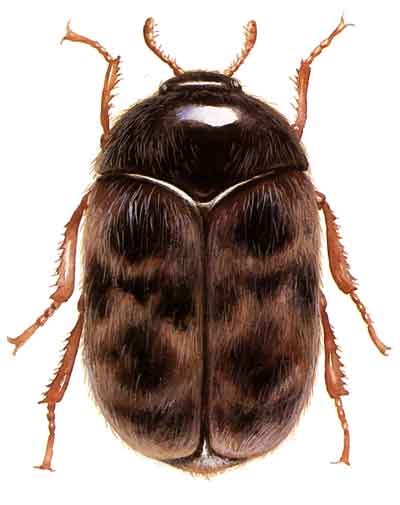
Khapra Beetle

Trogoderma granarium
There has been quite the tizzy recently over these tiny insects, and for very good reason. The Khapra Beetle is one of the most dangerous invasive species in the entire world! A specimen in larval form was found in a grain shipment that entered Chicago from India. That larvae was enough to reject the entire shipment; these guys are that bad. The last time the Unted States saw a major outbreak, in 1953, it took 13 years and several million dollars to eradicate.


So what is it that makes these guys so frightening? Well, their favorite foods are dry, low-moisture grains. This, coupled with their small size, the fact that they can live for long periods of time without food, and are resistant to many insecticides, adds up to some serious trouble. If the Khapra Beetle gets into a stored grain supply, it can lead to massive damage, and they are incredibly difficult to get rid of. They are considered to be one of the worst grain pests on the planets, and one of the world's worst invasive species.

Khapra Beetles are antive to India, but by this point they have spread to other parts of Asia, the Middle East, Africa, and several Mediterrannean countries. They measure only 2-3cm long as adults, and only about 5mm as larvae, so they are remarkable hard to detect if they get into a rice supply. They can consume food that contains as little as 2% moisture, which means that while they will eat all sorts of plant matter, stored grains are a particular favorite.

Though US Customs has been sucessful in keeping these Beetles ouf the country for 40 odd years, they number of interceptions has been particularily high this year. From January to April 2011 they had uncovered more Khapra beetles then in all of 2010 combined. Overall, the trend has been rising year to year, requiring more vigilance to keep the invading bug out. Shipments that contain evidence of only dead Beetles are even rejected, in order to really play it safe.

IUCN Status : Not Listed
Location : Originated in India
Size : Length up to 3cm
Classification : Phylum : Arthropoda -- Class : Insecta -- Order : Coleoptera
Family : Dermestidae -- Genus : Trogoderma -- Species : T. granarium

Thursday, January 24, 2013

Allenius iviei

Allenius iviei
Well hurray, it's time to learn about a brand new species! This recently discovered Ladybird Beetle is one of the rarest in the United States, and is known from only two specimens.

Allenius iviei was identified as a new species when a male landed on a trap set in Montana by entomology grad student Ross Winton. Winton at first thought that the tiny creature was a body part of an ant or another insect, not a whole specimen. Most confusing was the fact that the insect looked headless!

It was soon discovered that the Beetle was not headless at all-- it actually was able to retract it back into its thorax, much like how a turtle can pull their head into their shell. It was also discovered that the specimen was a male, and matched a female that was found in Idaho. Because there are now two examples, one of each sex, the insect was able to be declared a new species (with the species name derived from the name of Winton's adviser, Michael Ivie).

There is still much to learn about Allenius iviei. But for now it remains a rare, elusive, and unusual Ladybug. The head retracting, tiny size, and sand-dune habitat have made it unique enough to belong to a brand new genus, which it shares with A. californianus, another recent discovery.

IUCN Status : Not Listed
Location : United States
Classification : Phylum : Arthropoda -- Class : Insecta -- Order : Coleoptera
Family : Coccinellidae -- Genus : Allenius -- Species : A. iviei